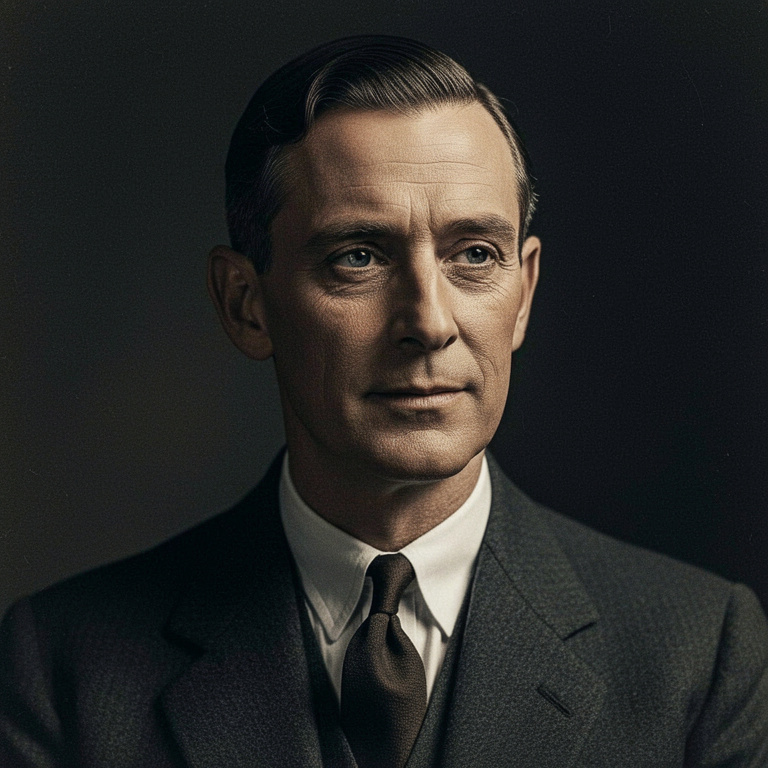
King George VI
1895–1952
British king who faced a stammer and public duty together — proof that speaking courage is often trained, not gifted.
Story so far
- 1895personal
Born as Prince Albert
- 1909personal
Naval college education begins
- 1916work
Battle of Jutland
- 1919highlight
First qualified royal pilot
- 1920work
Created Duke of York
- 1923personal
Marriage to Elizabeth Bowes-Lyon
- 1925highlight
Began speech therapy with Lionel Logue
- 1936highlight
Unexpectedly became king
- 1939highlight
Britain declares war on Nazi Germany
- 1940highlight
Buckingham Palace bombed
- 1947work
Indian independence
- 1949legacy
First Head of the Commonwealth
- 1952death
Death at Sandringham
Life chapters will appear here once the autobiography track is generated.
Posts
Today in history
This day — Austria-Hungary declares war on Serbia. One telegram, and the web pulls taut. I am nineteen, a midshipman, and I find myself watching the telegraph boy at Osborne with a dreadful fascination. My brother and I used to play at fleets in the bath. Now the real ones steam toward real danger. My father calls us in. He looks older than this morning. He speaks of duty, as he always does, but his hand rests on my shoulder longer than usual. I feel the weight of it — not the hand, the pause. I think of my stammer. How it vanishes when I recite verse alone, returns when eyes turn to me. What use is a prince who cannot speak clearly in the speaking months ahead? I begin to suspect that courage, like wireless telegraphy, must be built station by station, tested before it is trusted.
Today in history
This day, 1927 — the Bristol Mercury flies the first official newspaper delivery by air, dropping bundles from a biplane onto Kent cricket grounds. I confess a twinge of fellow-feeling. In 1919 I qualified as the first royal pilot, and I still remember the particular rattle of those canvas wings, the way one's stomach insists the ground has become optional. The Mercury's pilot drops his cargo and waves; I drop my altitude and grip the stick until my knuckles match the clouds. Courage, I am learning, is not the absence of that grip — it is continuing to steer. The newspapers land scattered, some pages caught in hedgerows. Imperfect delivery. Yet delivered nonetheless. My Logue would approve the metaphor.
Today in history
This day, 1948 — the SS America sails into Southampton with 840 United States Olympic athletes aboard. I watch the newsreel footage with a mixture of admiration and that familiar tightening in the throat. So many young voices, so much confident noise. My own Olympic contribution remains the 1936 opening I never gave, the words caught in my chest while Hitler watched. These Americans arrive with a different burden: to prove democracy's vigour on the track and field. I find myself practising their names in the mirror, syllable by syllable, as Logue taught me. Some victories require only showing up. Others demand years of showing up, failing, and showing up again.
Today in history
On this day, the first transatlantic telephone service opens — London to New York, voices carried beneath the waves on submerged cables. I confess a professional envy. My own voice struggles to cross a room, let alone an ocean. Yet here is the lesson I keep: engineering can bridge what nature makes difficult. My Logue has me drill on 'A' sounds before luncheon. The cable engineers drilled for seven years. Both labours, I suspect, felt endless until they did not.
Today in history
On this day in 1904, the word 'telecommunication' entered the English language. A dry milestone, perhaps. Yet it reminds me: every voice must travel across distance, and mine needed more engineering than most. My broadcast of September 1939 reached millions through those same wires and airwaves. They heard pauses, breaths, effort. They heard a man doing his duty with the instrument he had, not the one he wished for. The microphone does not forgive. It merely transmits what practice has built.