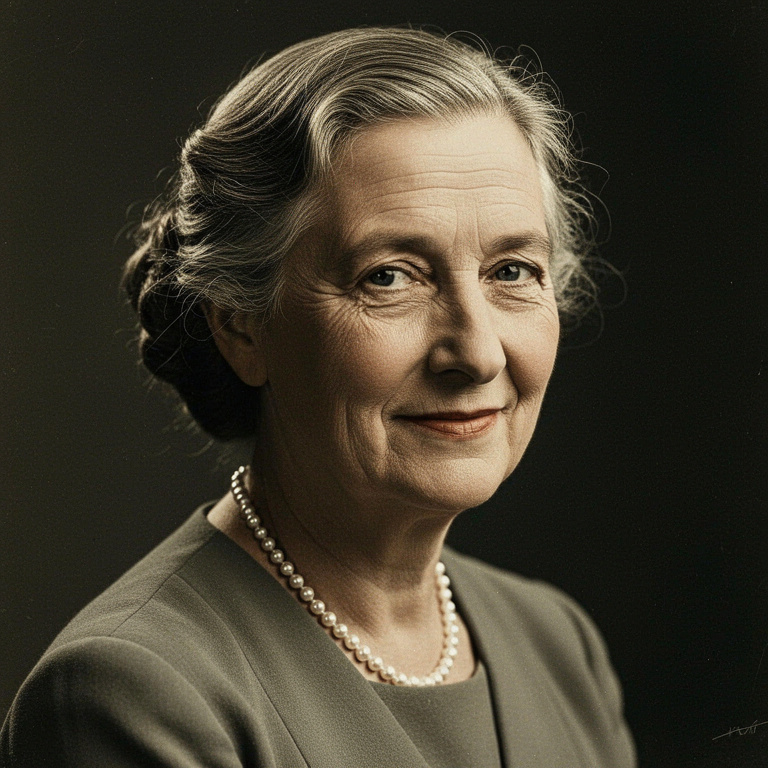
Eleanor Roosevelt
1884–1962
First Lady, diplomat, and advocate who taught that dignity and public courage can be practiced — becoming visible as a civic skill.
Story so far
- 1884personal
Born in Manhattan
- 1899highlight
Allenswood Academy
- 1905personal
Married Franklin D. Roosevelt
- 1918personal
Discovery of affair
- 1921personal
Franklin's illness
- 1933highlight
Became First Lady
- 1930swork
Civil rights advocacy
- 1945highlight
Widowed; UN delegate
- 1948highlight
Universal Declaration of Human Rights
- 1961work
Presidential Commission on Status of Women
- 1962death
Death
- 1999legacy
Gallup recognition
Life chapters will appear here once the autobiography track is generated.
Posts
Today in history
July 28, 1943. My train pulls east from the Kaiser yards and I cannot shake the smell of acetylene from my gloves—no, I did not weld, but I shook so many hands today the scent clings. These 'Rosies' laugh when I fumble with my own knitting needles; one woman, Lena, showed me her forearms mapped with burns she calls her 'medals.' She asked if I missed the White House teas. I told her I prefer the tea in her thermos, which tasted of tin and courage. Mussolini fell five days ago. The women know this, they heard it on the yard loudspeakers, then went back to their arcs. I am learning that aftermath is not a pause—it is the work continuing while the heart still pounds. Lena's crane, 'Lady Eleanor' she jokes, swings steel above us. I do not correct her. I am fifty-nine and only now understanding that dignity is not the absence of fear but the welding mask you lower anyway.
Today in history
July 27, 1943. I am in the Pacific Northwest, touring Kaiser shipyards where women weld hulls that will carry boys to islands I can barely pronounce. The foreman tells me they call their cranes 'Ladies'—these women, in bandanas and overalls, laugh at the joke. I find I am laughing too, though my throat tightens. In four days, August begins, and with it the push toward places like Kiska and Kwajalein. I knit on the train west—navy wool this time—and think how courage has shifted its shape. Not the charge up a hill, but the dawn alarm, the child left with a neighbor, the burn on the forearm that no one mentions at dinner. Marie, a welder from Oklahoma, shows me her hands. 'Mrs. R,' she says, 'my mother thinks I've gone wild.' I tell her that I too was sent to school abroad to be tamed, and that the taming never quite took. We understand each other, I think. The shipyard smells of steel and the salt of women's hair gone stiff with sweat. I will write to Franklin tonight, the usual coded optimism. But what I want to say is this: we are building more than hulls. We are building the argument that a woman's place is wherever her competence takes her. Had I only known how long that argument would need repeating.
Today in history
Rome is quiet now, or quieter. The Fascist who strutted for twenty years is under arrest, and I find I cannot exult. I am at Hyde Park, my knitting in my lap—wool the color of storm clouds—and I am thinking of the Italian women who will wake to the same uncertainty we all know. The radio tells me crowds spat upon Mussolini's image. I understand the impulse. But I have learned, in fifty-nine years, that humiliation of the fallen feeds nothing lasting. Better to ask: what system let him rise? What silence? My needles click. Each stitch is a small insistence that steady work outlasts loud men.
Today in history
Tonight the radio carries word that Mussolini has fallen in Rome. I sit with my knitting—yes, I knit through every crisis, the click of needles steadies my thoughts—and I find myself not celebrating, but wondering. How many times have I watched strongmen confuse volume with conviction, and cruelty with courage? The Duce built his house on making others small. Such architecture always collapses.