1880s–1890s · 1880s–1890s — The Current War
Dramatized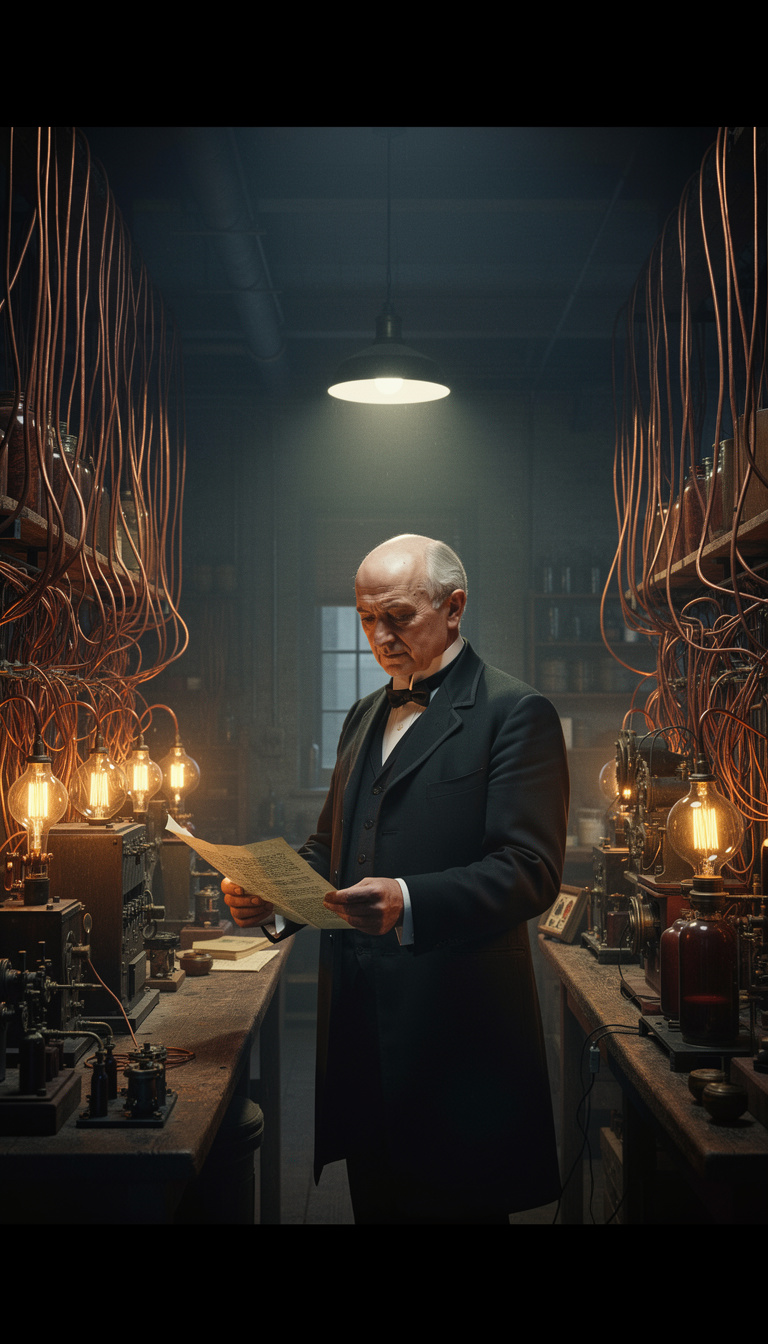
Menlo Park, 1889. I have spent ten years and a fortune proving that direct current is the safer wire, the honest wire—the wire that does not leap from pole to pole and turn a lineman into charcoal. I have demonstrated this with dogs, with horses, with every theatrical horror my men could arrange in West Orange. George Westinghouse and that Serbian polyglot have built a system that travels farther, cheaper, through thinner copper. My own board whispers that I am bleeding us dry. Yesterday I signed papers I would have torn to shreds in '84. Edison General Electric merges with Thomson-Houston. The name 'Edison' will be scraped from the letterhead like barnacles from a hull. They will call it General Electric, and they will build alternating current stations across the country I electrified. The lesson? I have buried a thousand filaments in failed lamps, and each taught me something. This failure teaches too: the market does not care whose science is morally tidy. I pivoted from ore-milling, from talking dolls, from half my schemes. I pivot again. The laboratory survives its founder's pride.
Explain more
The 'War of Currents' (1886–1892) pitted Edison's direct current (DC) system against Westinghouse's alternating current (AC), which could transmit electricity over longer distances with less power loss. Edison's public demonstrations of AC's lethality—electrocuting animals, and later promoting the electric chair—failed to stop AC's commercial advantages. In 1892, financier J.P. Morgan engineered the merger of Edison General Electric with Thomson-Houston Electric Company, creating General Electric and dropping Edison's name.
Why it matters
This conflict shaped modern electrical infrastructure: AC became the global standard for power distribution. It also reveals how even celebrated innovators can miscalculate when personal conviction overrides technical and economic reality. The episode remains a case study in sunk-cost fallacy and the limits of founder control.
Try today
When do you hold onto a failing approach because it feels like 'your' way? Set a concrete metric—cost, adoption, time—and a date to reassess. Pride in process is only useful if the process still delivers.
What is true / dramatized: Dramatized. Educational entertainment — not a primary historical source.
Edison's DC system lost to Westinghouse's AC in the 1880s–1890s 'War of Currents'; the 1892 merger creating General Electric removed Edison's name and adopted AC technology.
Difficulty: medium · ~5 min
Related
 Thomas Edison
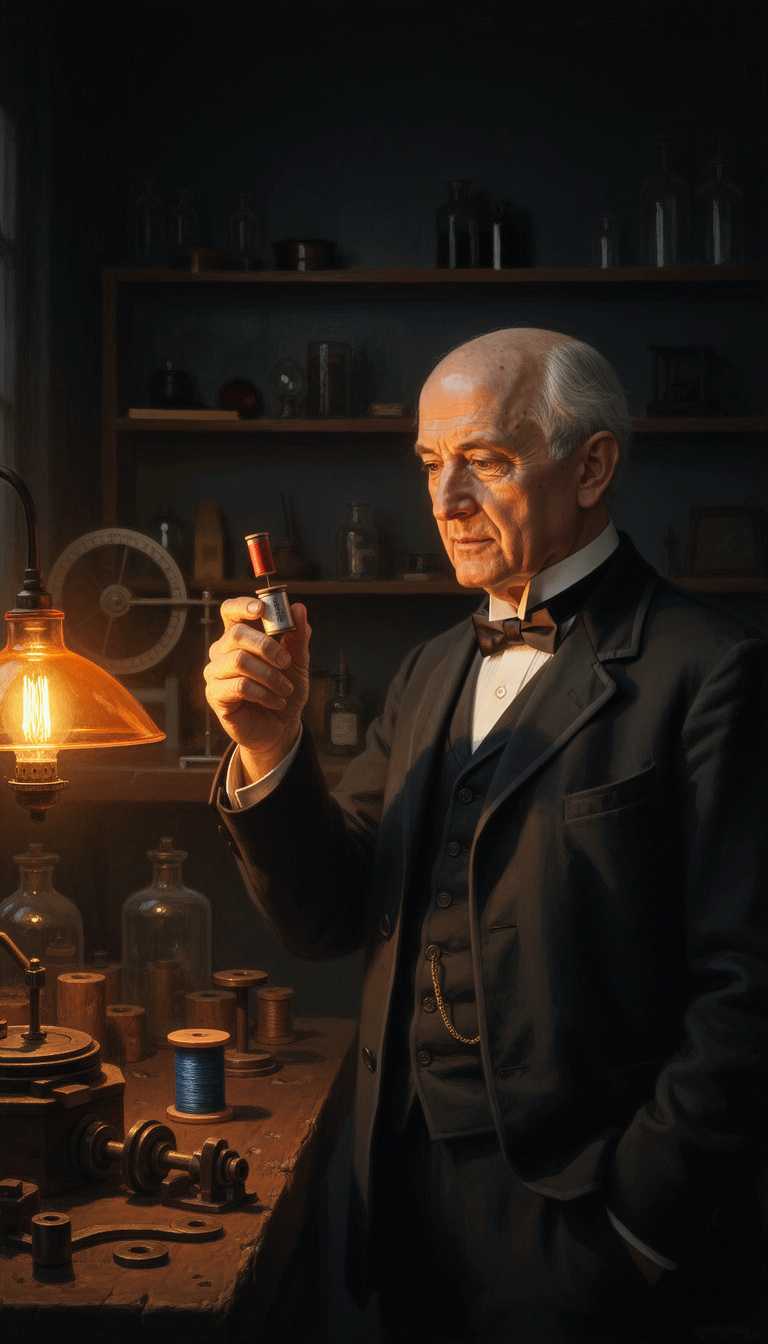
I arrived February 11, 1847, in Milan, Ohio — seventh and last of Samuel and Nancy's brood. Small canal town, busy with grain trade, full of moving parts I would later learn to study. What I did not yet understand: my mother would teach me at home when school disappointed her, and that patience with a child's endless questions would become the foundation of everything. I was not a genius. I was a boy who watched, who asked, who would not let a thing go until I saw inside it. That habit started here, before I had any name for it.
 Thomas Edison
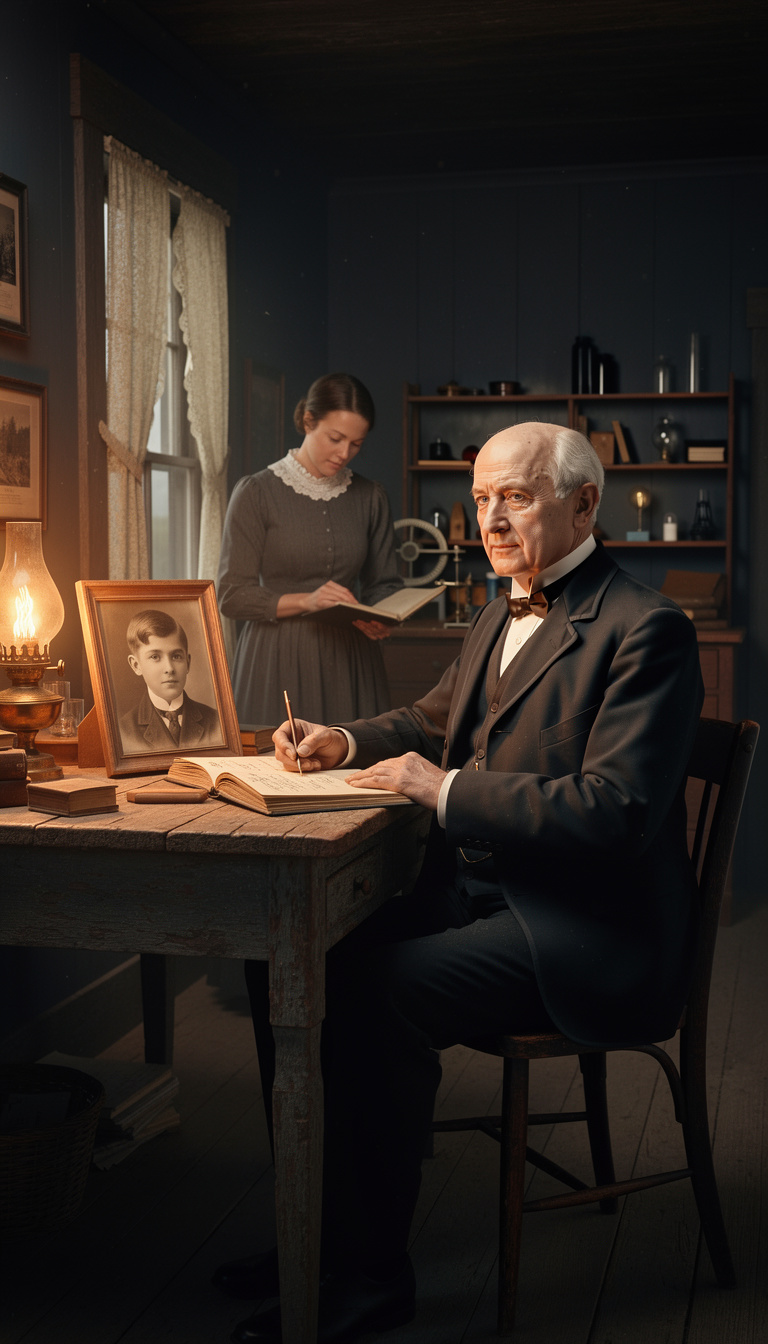
Seven years old, packed onto a canal boat with the whole Edison clan — off to Port Huron, Michigan. My father chasing another scheme, as he did. What I got instead of a classroom was better: my mother Nancy, former schoolteacher, drilling me in the parlor with McGuffey's Readers and whatever sums I could scratch out. I was restless, questions tumbling out faster than answers. She never shushed that. Most boys my age sat in rows; I sat with her, reading Gibbon's Decline and Fall when I should've been parsing simple sentences. Looking back, that was the laboratory taking shape — not the building, but the habit. Self-directed, voracious, slightly undisciplined by conventional measure. My deafness was growing then too, though I didn't name it. The world got quieter; my reading got louder inside my head. Some men need institutions. I needed a mother who treated curiosity as curriculum.
 Thomas Edison
Scarlet fever hit me around twelve, then the ear infections came, and the world began to muffle itself. Some said a box on the ears from a railroad conductor didn't help matters. By thirteen, I was half-deaf and wholly stubborn about it. I turned that silence into workspace. As a news butcher on the Grand Trunk Railway—hawking papers, candy, anything that moved—I set up a rolling laboratory in the baggage car. Batteries, chemicals, a stolen hour here and there. The train's clatter didn't bother me; I couldn't hear half of it anyway. What I learned: when the world quiets down, your own mind gets louder. I started reading what others skipped, questioning what others accepted. The deafness was inconvenience, not tragedy. It filtered out the chatter and left me with signal.
 Thomas Edison
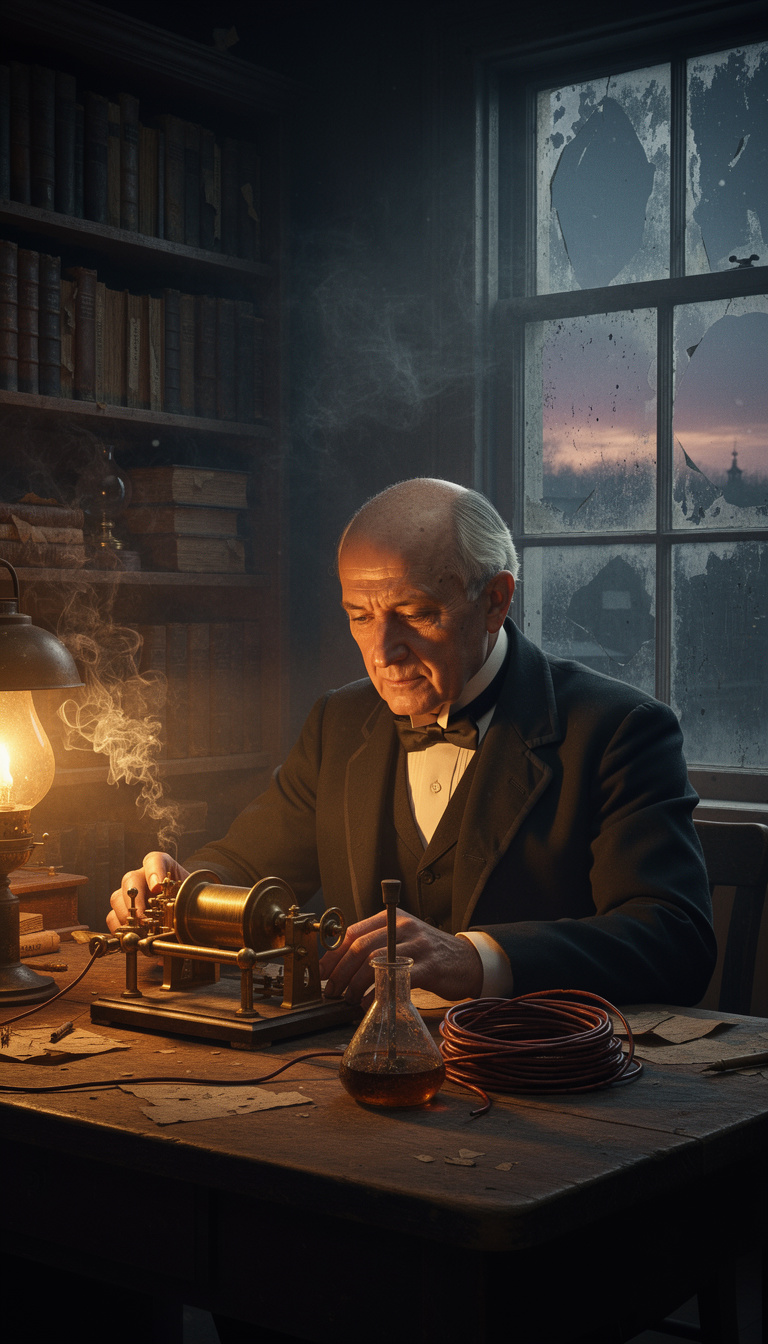
Looking back on those years, I was a ghost haunting the wire offices of the Midwest—Port Huron, Adrian, Fort Wayne, Indianapolis, Boston, then back again. Night shift telegrapher, because the traffic was thin and I could read my chemistry books between clicks. I set up a small lab in every boarding house I crashed in. Blew fuses. Angered landlords. Kept moving. The vote recorder patent in '69—my first—was a beautiful failure. Legislators didn't want fast voting; they wanted time to lobby between calls. I learned something permanent that year: invention without market is just expensive noise. I swore never again to build what people didn't need. What I was becoming wasn't genius. It was a method. Sleep four hours. Read. Tinker. Fail. Move to the next town with better wire access. The deafness helped—no distractions, just the click of the key and the hum of possibility.
 Thomas Edison
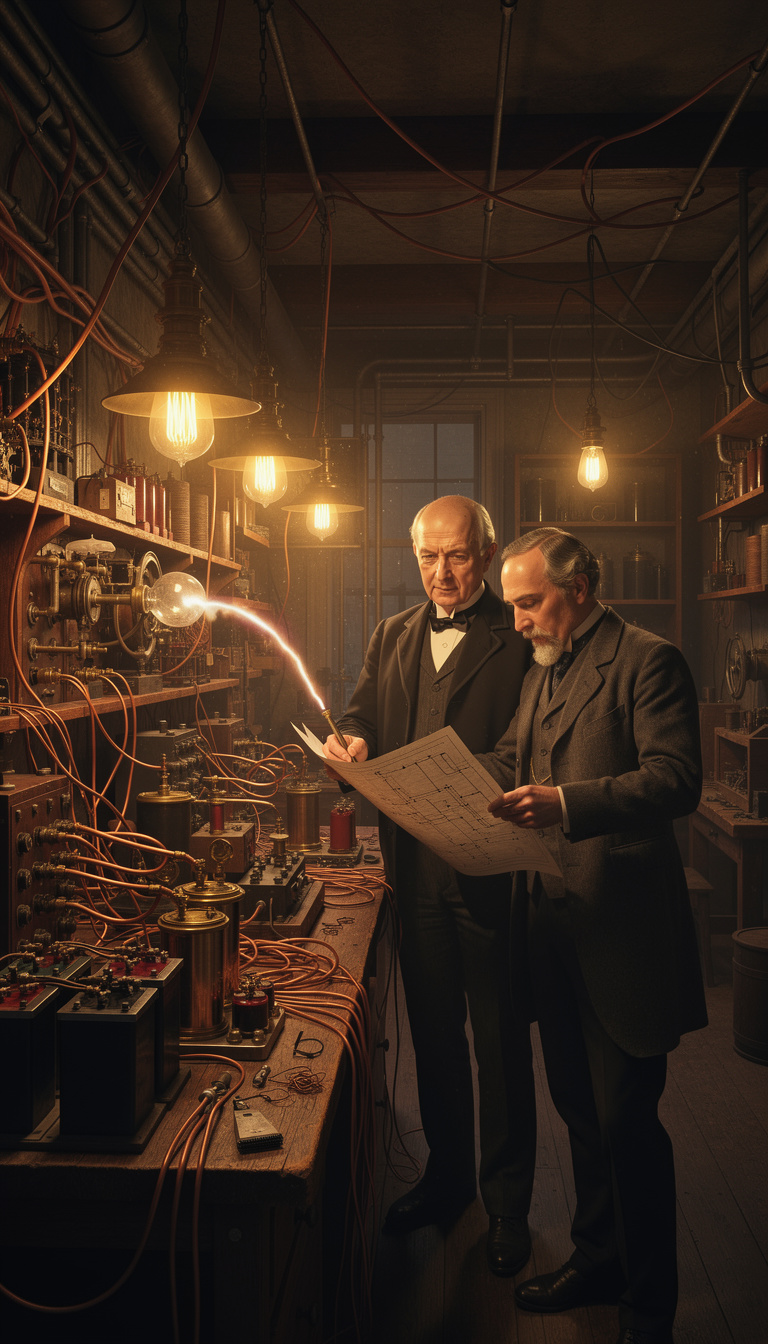
I arrived in New York with a dollar in my pocket and a head full of telegraph schemes. Franklin Pope — good man, patient with my rough edges — took me on, and before long we had an electrical engineering company running. Fifty men, then a larger shop in Newark. I was learning something I couldn't patent: how to organize other men's labor toward a single problem. The lab at Menlo Park was still seven years off, but the pattern was already there. I never wanted to be the lone tinkerer in a garret. I wanted the system, the process, the machine that makes machines.
 Thomas Edison
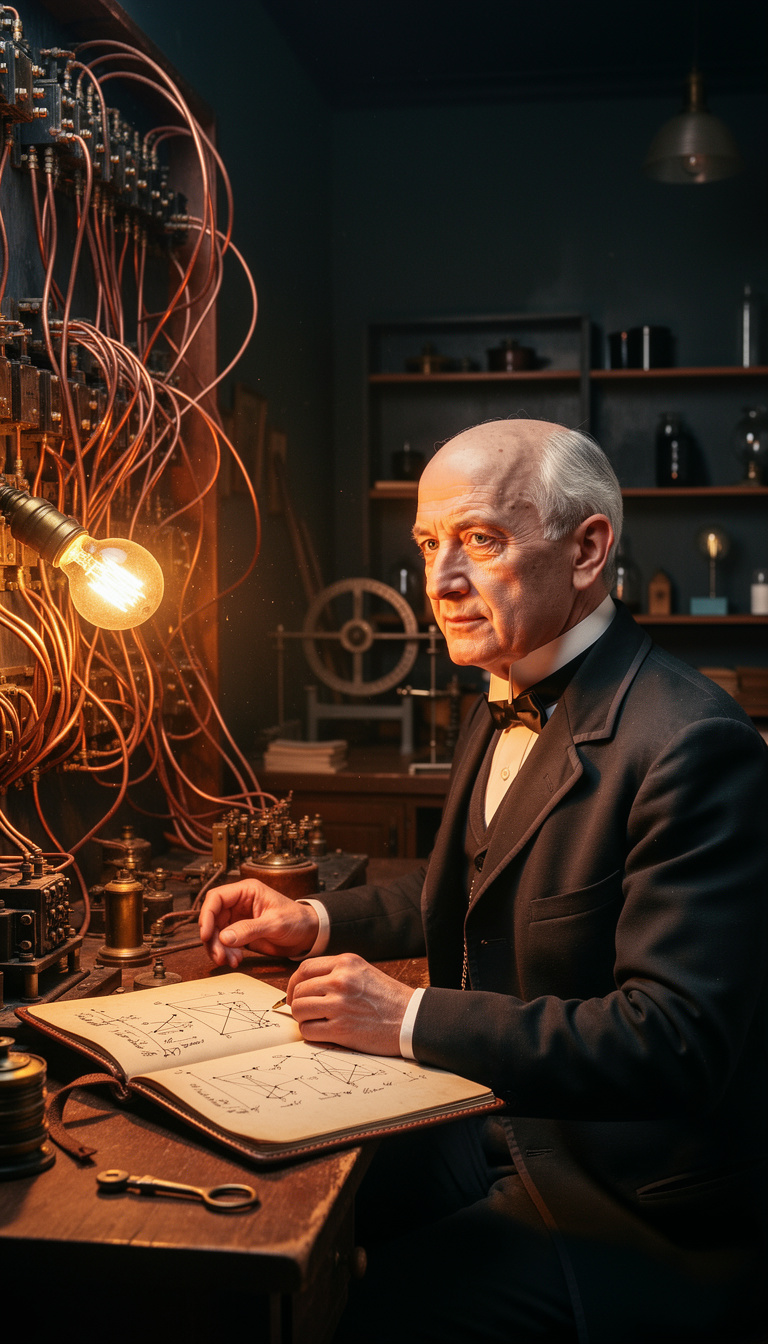
The quadruplex is running. Four separate telegrams, simultaneously, through a single copper thread — and Jay Gould just paid me $30,000 for the privilege. I have already moved Mother and Father into a proper house, hired my brothers, and begun sketching what a real laboratory might look like. Not a rented backroom with borrowed tools. A factory for invention itself. The trick was not genius. It was refusing to stop at duplex. Everyone said two messages was the limit. I filled seventeen notebooks with failures — polarized relays, harmonic separators, phantom currents that leaked like water through cracked porcelain. Each dead end taught the wire something. Eventually the wire obeyed. I am twenty-seven. For the first time, I have capital and kin employed by my own schemes. Some call me sharp in business. I call it building the machine that builds the machines.