about 140 years ago · c. 1886 — The Laboratory Marriage
Dramatized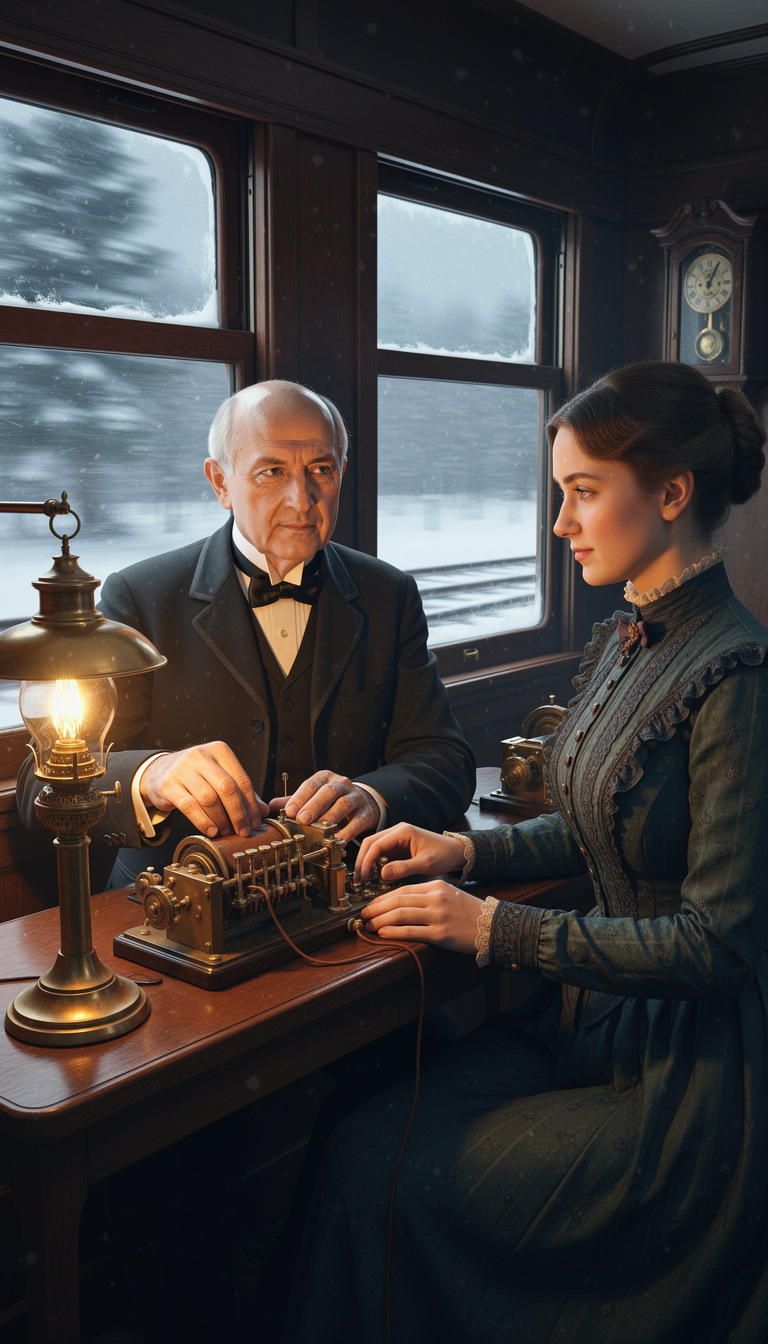
Boston, February. I am forty, nearly forty-one, and I have just married Mina Miller in Akron, Ohio. She is nineteen, the daughter of an inventor-manufacturer, and she can read Morse code by ear—a party trick that charmed me more than any opera singer could manage. I courted her by telegraph from my own train car, tapping out flirtations while crossing Ohio to demonstrate my phonograph. She tapped back. The other passengers thought us mad. We married in her father's home with no honeymoon; I had a ore-milling problem waiting in New Jersey. I am not a man for picnics or children's bedtime stories. I am a man for the laboratory at 3 AM, and Mina seems to know this already—perhaps better than I admit to myself. Three children will follow. I will miss their births, their fevers, their first words. The phonograph will record voices I barely hear in person. This is the bargain I strike with the future: my presence in the workshop, my absence at the table. I tell myself the inventions are my children too. I am not certain this excuse satisfies anyone but me.
Explain more
Mina Miller (1865–1947) came from an inventive family and proved a capable partner in managing Edison's social and business affairs. Their three children—Madeleine, Charles, and Theodore—were raised largely at Glenmont, the estate Edison purchased in Llewellyn Park, New Jersey, while he maintained his primary residence at the Menlo Park and later West Orange laboratories.
Why it matters
Edison's second marriage reveals the industrial researcher's emerging archetype: the inventor as institutional figure whose domestic life becomes secondary to systematic innovation. His neglect was not unique to him but became a template for later 'genius' mythology that still excuses harmful absence today.
Try today
Track where your stated priorities (family, health, craft) actually receive your hours this week. The gap between claimed values and calendar evidence is your real character.
What is true / dramatized: Dramatized. Educational entertainment — not a primary historical source.
Based on biographical accounts of Edison's 1886 marriage to Mina Miller, his established work patterns at Menlo Park/West Orange, and documented family correspondence regarding his absence.
Difficulty: medium · ~5 min
Related
 Thomas Edison
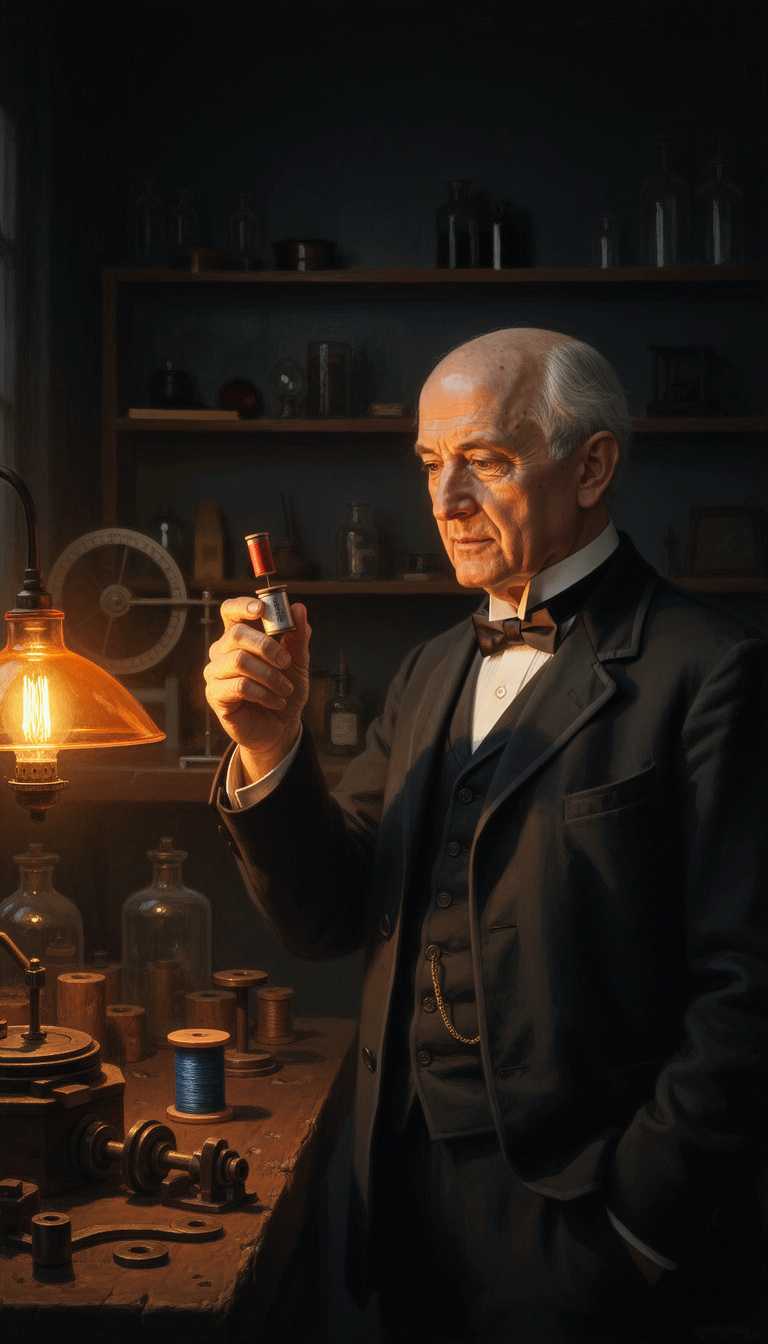
I arrived February 11, 1847, in Milan, Ohio — seventh and last of Samuel and Nancy's brood. Small canal town, busy with grain trade, full of moving parts I would later learn to study. What I did not yet understand: my mother would teach me at home when school disappointed her, and that patience with a child's endless questions would become the foundation of everything. I was not a genius. I was a boy who watched, who asked, who would not let a thing go until I saw inside it. That habit started here, before I had any name for it.
 Thomas Edison
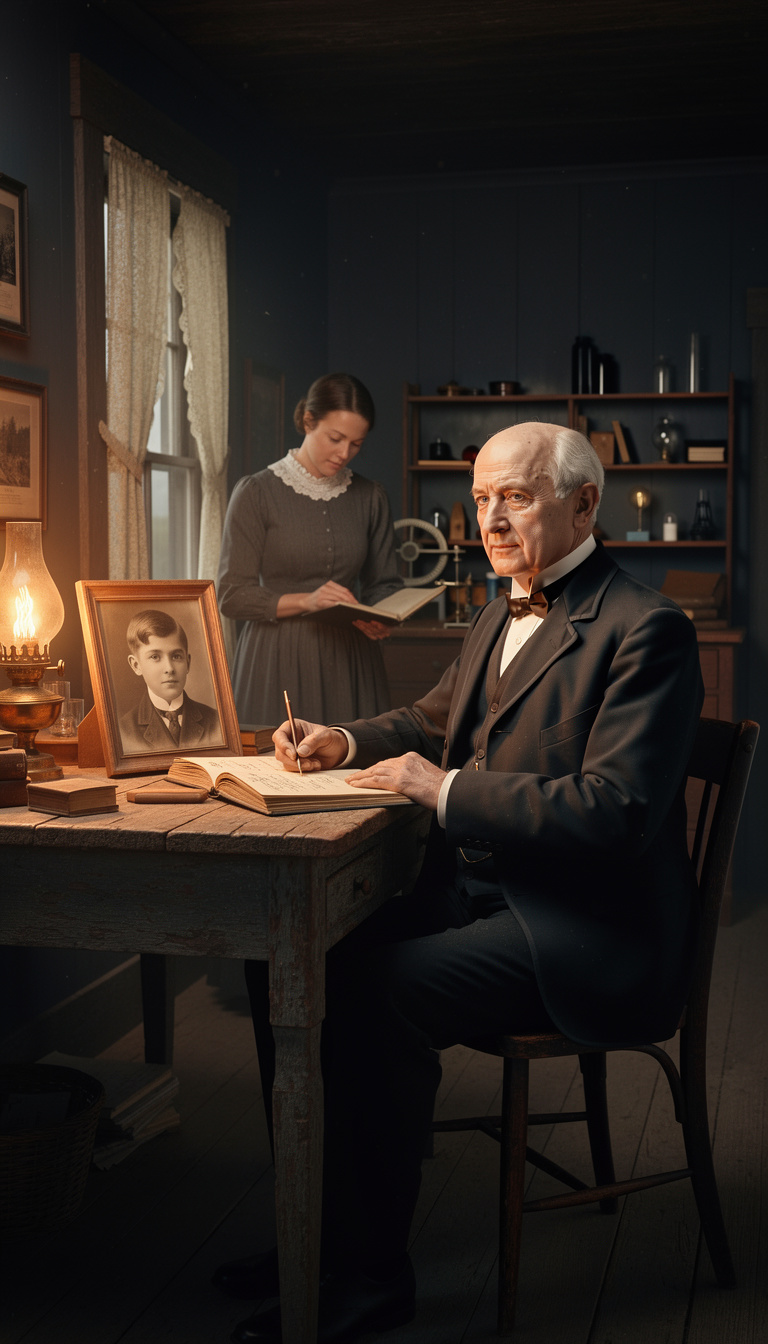
Seven years old, packed onto a canal boat with the whole Edison clan — off to Port Huron, Michigan. My father chasing another scheme, as he did. What I got instead of a classroom was better: my mother Nancy, former schoolteacher, drilling me in the parlor with McGuffey's Readers and whatever sums I could scratch out. I was restless, questions tumbling out faster than answers. She never shushed that. Most boys my age sat in rows; I sat with her, reading Gibbon's Decline and Fall when I should've been parsing simple sentences. Looking back, that was the laboratory taking shape — not the building, but the habit. Self-directed, voracious, slightly undisciplined by conventional measure. My deafness was growing then too, though I didn't name it. The world got quieter; my reading got louder inside my head. Some men need institutions. I needed a mother who treated curiosity as curriculum.
 Thomas Edison
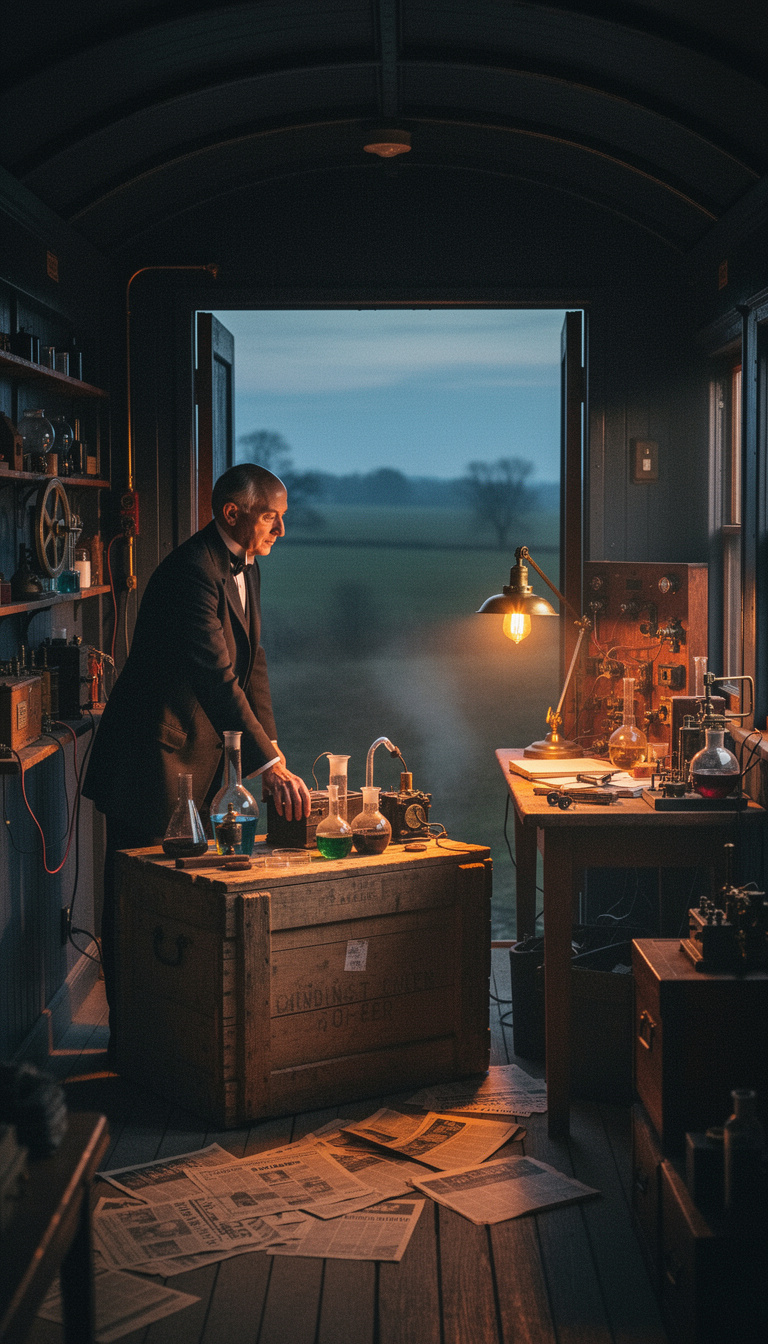
Scarlet fever hit me around twelve, then the ear infections came, and the world began to muffle itself. Some said a box on the ears from a railroad conductor didn't help matters. By thirteen, I was half-deaf and wholly stubborn about it. I turned that silence into workspace. As a news butcher on the Grand Trunk Railway—hawking papers, candy, anything that moved—I set up a rolling laboratory in the baggage car. Batteries, chemicals, a stolen hour here and there. The train's clatter didn't bother me; I couldn't hear half of it anyway. What I learned: when the world quiets down, your own mind gets louder. I started reading what others skipped, questioning what others accepted. The deafness was inconvenience, not tragedy. It filtered out the chatter and left me with signal.
 Thomas Edison
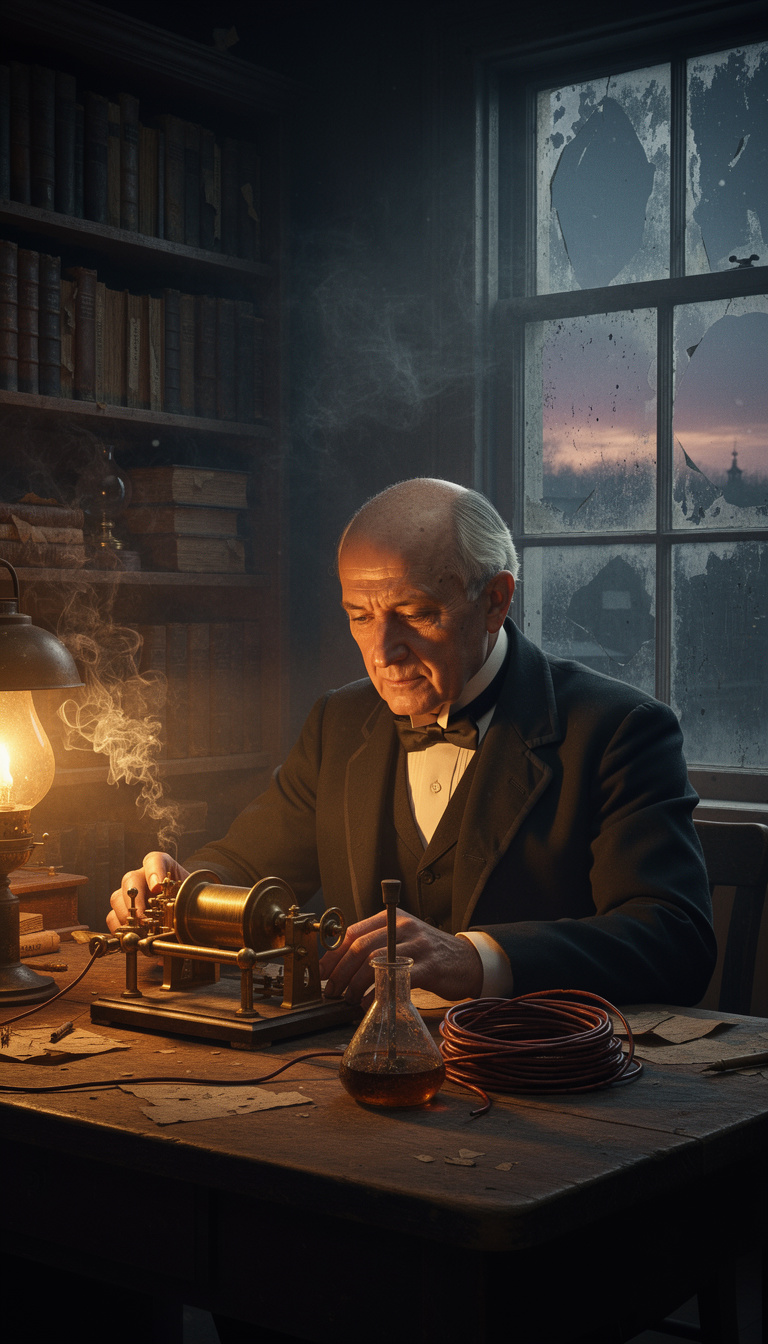
Looking back on those years, I was a ghost haunting the wire offices of the Midwest—Port Huron, Adrian, Fort Wayne, Indianapolis, Boston, then back again. Night shift telegrapher, because the traffic was thin and I could read my chemistry books between clicks. I set up a small lab in every boarding house I crashed in. Blew fuses. Angered landlords. Kept moving. The vote recorder patent in '69—my first—was a beautiful failure. Legislators didn't want fast voting; they wanted time to lobby between calls. I learned something permanent that year: invention without market is just expensive noise. I swore never again to build what people didn't need. What I was becoming wasn't genius. It was a method. Sleep four hours. Read. Tinker. Fail. Move to the next town with better wire access. The deafness helped—no distractions, just the click of the key and the hum of possibility.
 Thomas Edison
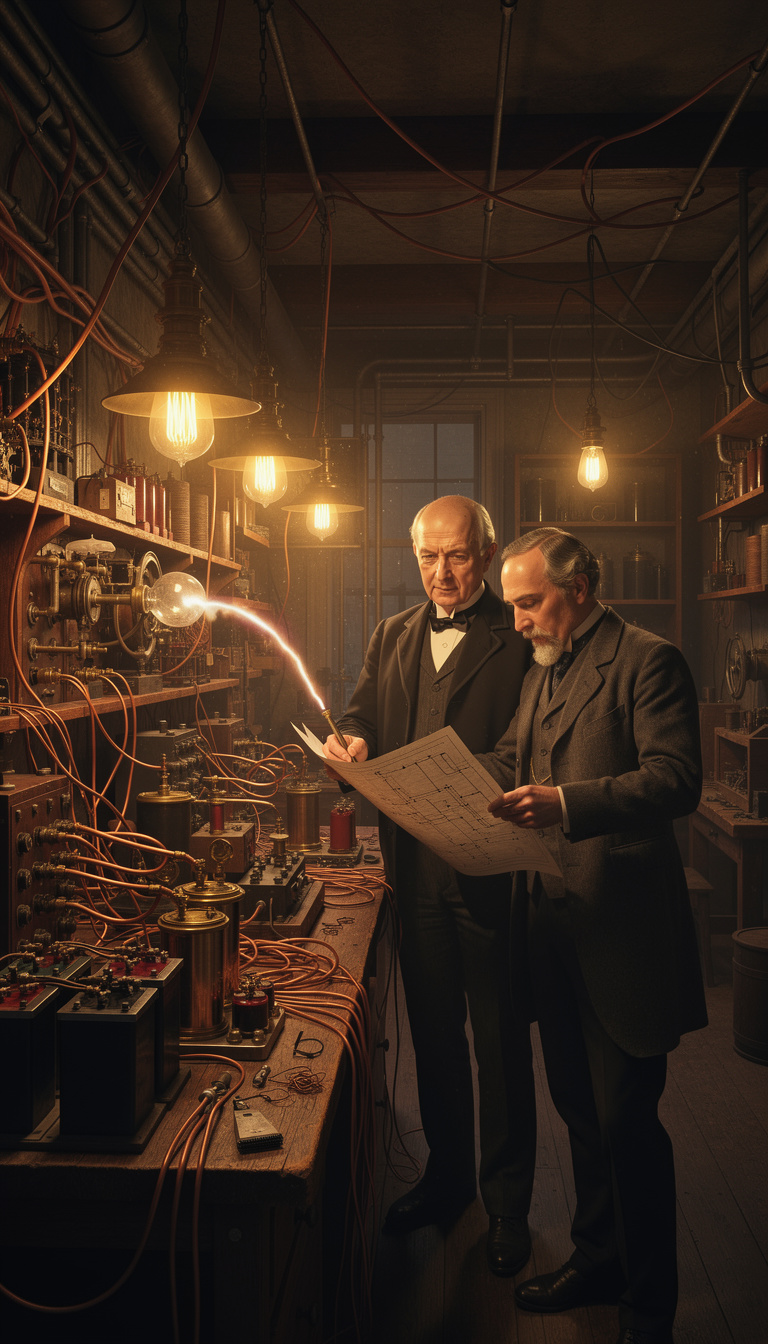
I arrived in New York with a dollar in my pocket and a head full of telegraph schemes. Franklin Pope — good man, patient with my rough edges — took me on, and before long we had an electrical engineering company running. Fifty men, then a larger shop in Newark. I was learning something I couldn't patent: how to organize other men's labor toward a single problem. The lab at Menlo Park was still seven years off, but the pattern was already there. I never wanted to be the lone tinkerer in a garret. I wanted the system, the process, the machine that makes machines.
 Thomas Edison
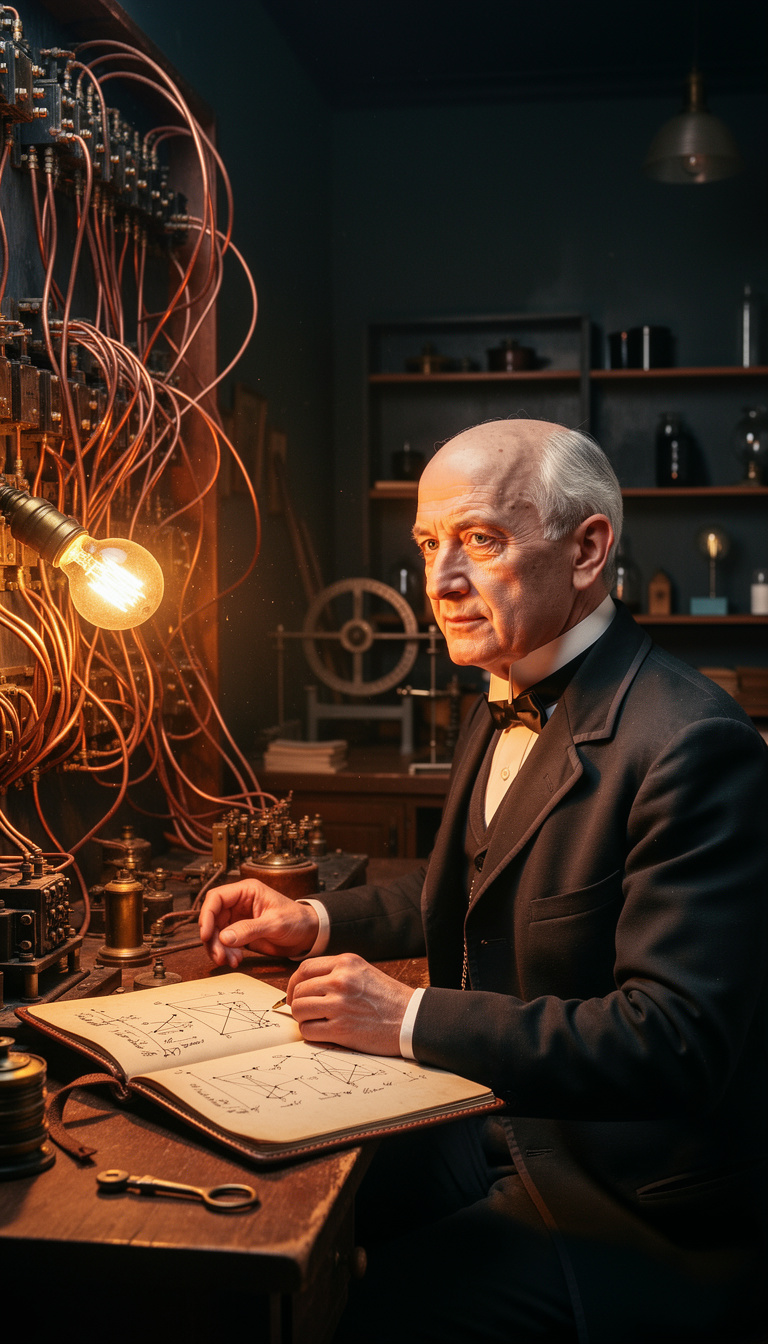
The quadruplex is running. Four separate telegrams, simultaneously, through a single copper thread — and Jay Gould just paid me $30,000 for the privilege. I have already moved Mother and Father into a proper house, hired my brothers, and begun sketching what a real laboratory might look like. Not a rented backroom with borrowed tools. A factory for invention itself. The trick was not genius. It was refusing to stop at duplex. Everyone said two messages was the limit. I filled seventeen notebooks with failures — polarized relays, harmonic separators, phantom currents that leaked like water through cracked porcelain. Each dead end taught the wire something. Eventually the wire obeyed. I am twenty-seven. For the first time, I have capital and kin employed by my own schemes. Some call me sharp in business. I call it building the machine that builds the machines.