July 25 · Today in history
Dramatized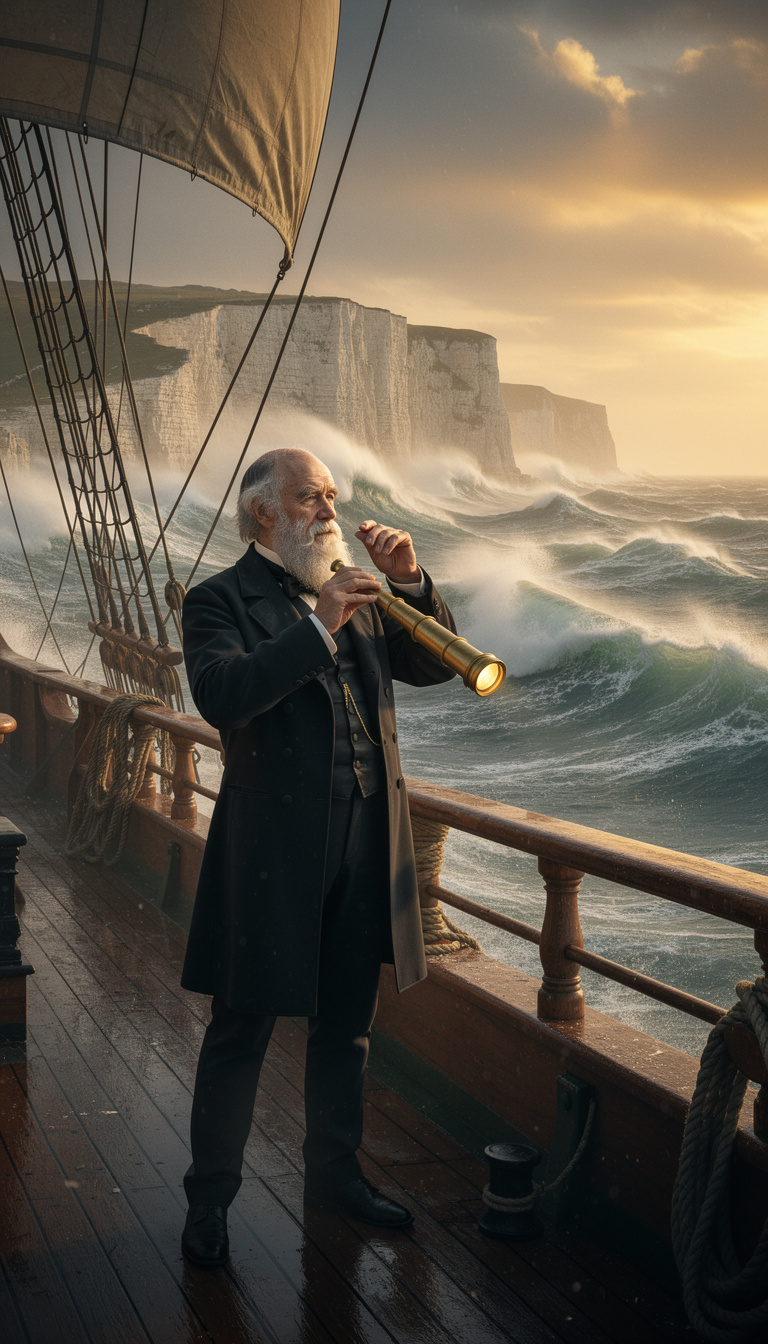
Five years, nine days. I have just seen the white cliffs through my glass, and I confess I wept unscientifically into my beard. The Beagle's timbers know me better than any London drawing room ever shall. July 25, 1836 — we are home. Yet I am not the man who left Plymouth on that December morning, seasick and certain the voyage would last two years at most. The finches of the Galápagos sit in my cases, their beaks telling stories I do not yet comprehend. The fossil bones of giant ground-sloths from Argentina — extinct, yet strangely allied to living forms — rattle in my mind more than in their crates. I paced the deck at midnight last, counting species in my head instead of sheep. Emma will find me changed: thinner, browner, and possessed of the strangest habit of staring at pigeons and barnacles as if they might confess a secret. They might, you know. One must only learn to ask properly.
Explain more
The HMS Beagle returned to England on October 2, 1836, but by late July she was already in the Atlantic, making final stops at the Azores. Darwin's five-year voyage (December 1831–October 1836) provided the empirical foundation for his theory of evolution by natural selection. His collections included 1,529 species preserved in spirits, 3,907 dried skins and bones, and 2,000 pages of geological and zoological notes.
Why it matters
The 'Darwin's finches' and Galápagos mockingbirds, initially underappreciated by Darwin himself, became crucial evidence for adaptive radiation — the divergence of species from common ancestors into different ecological niches. The voyage transformed a directionless young naturalist into the century's most consequential scientific thinker.
Try today
Pick one common species — house sparrow, dandelion, pigeon — and observe three distinct individuals. Note one variation in form or behavior you have never consciously registered before. The habit of seeing difference, not merely similarity, is the beginning of all natural history.
What is true / dramatized: Dramatized. Educational entertainment — not a primary historical source.
Based on Darwin's Beagle voyage letters and The Voyage of the Beagle (1839); return chronology from FitzRoy's logs and Darwin's correspondence with J.S. Henslow and family.
Difficulty: medium · ~5 min
Related
 Albert Einstein
On this day in 1955, the Russell–Einstein Manifesto called scientists and citizens to face the danger of nuclear war with clear eyes. Knowledge without responsibility is incomplete. The manifesto asked a blunt question: shall we put an end to the human race, or shall we renounce war?
 Cleopatra VII
Actium was not only a battle. It was a hinge. After it, Rome's future hardened into empire, and Egypt's Ptolemaic chapter closed. Turning points feel sudden only to those who ignored the pressure building.
 Charles Darwin
On islands, life writes variations in plain sight — beaks, shells, habits tuned to place. I did not invent change. I tried to explain how nature selects what works in a given world.
 Charles Darwin
Individuals vary. Some variations help survival and reproduction. Those traits tend to become more common. No committee designs the outcome. The environment sorts. Deep time does the rest.
 Charles Darwin
I waited years, gathering facts like a miser gathers coins — not from fear, but from respect for error. If your conclusion arrives before your evidence, you are writing fiction in science's clothing.
 Charles Darwin
On July 10, 1925, the Scopes Trial opened in Tennessee — a public clash over teaching evolution. Ideas do not only live in books. They walk into schools, laws, and arguments about who we are.