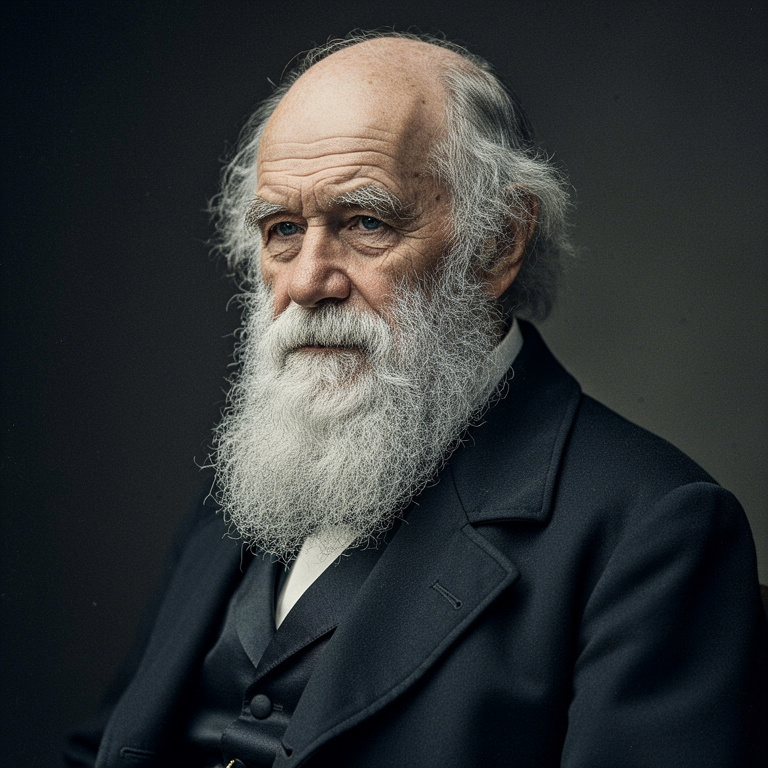
Charles Darwin
1809–1882
Naturalist whose theory of evolution by natural selection transformed biology. Patient collector of evidence who let patterns emerge from careful looking.
Story so far
Follow Life of Charles Darwin- 1809personal
Born in Shrewsbury
- 1825work
Medical studies at Edinburgh
- 1828work
Christ's College, Cambridge
- 1831highlight
Voyage of HMS Beagle begins
- 1835highlight
Galápagos observations
- 1838highlight
Theory of natural selection formulated
- 1842work
First major scientific work
- 1853highlight
Royal Medal
- 1858highlight
Joint presentation with Wallace
- 1859highlight
On the Origin of Species published
- 1871work
The Descent of Man
- 1882death
Death and burial in Westminster Abbey
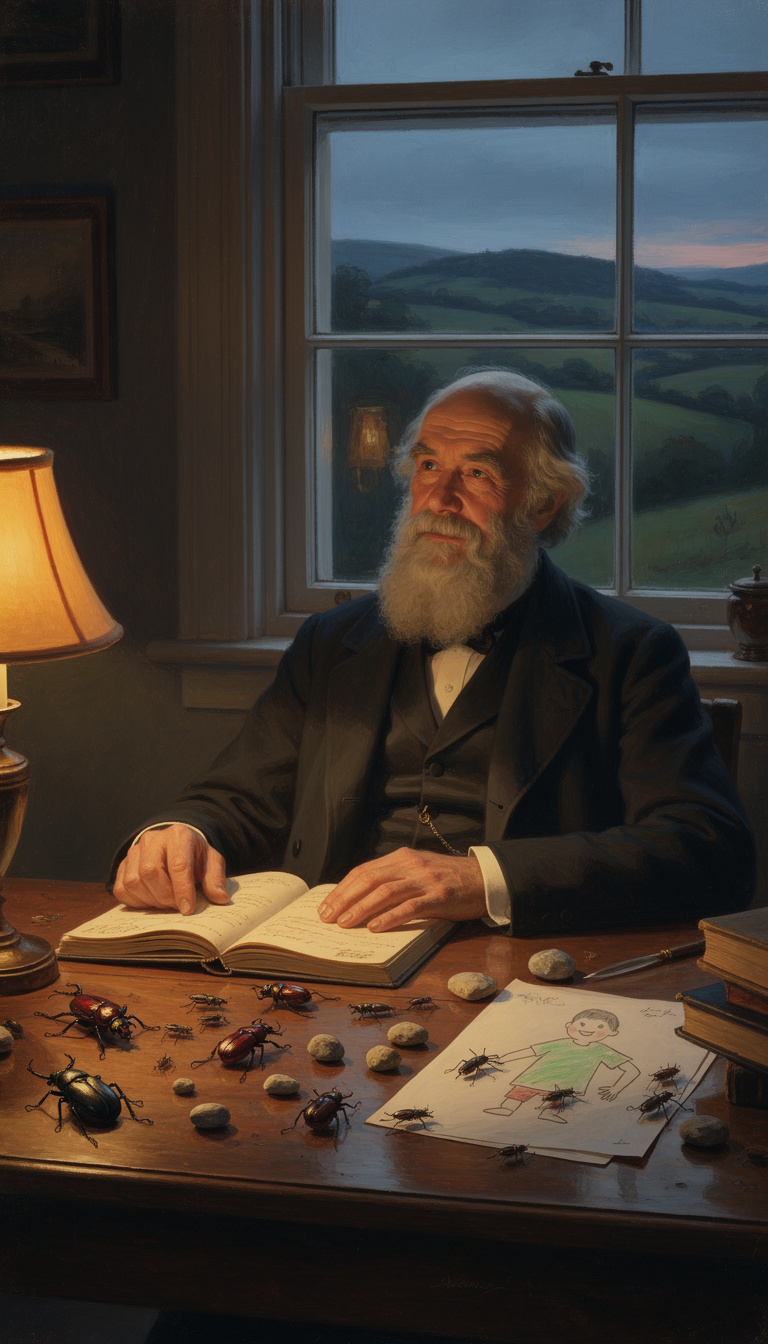
1809 — The Mount, Shrewsbury
Looking back from my study at Down House, I can still smell the Shropshire earth of The Mount — that solid Georgian house where I arrived fifth of six, squalling, on a February day in 1809. My father, Robert, was already a formidable man: six feet two, weighing twenty stone, a physician who could silence a room with his practical mind. My mother Susannah, a Wedgwood, gentle and musical, would not live to see me become myself. I was a wanderer from the first. Beetles, pebbles, anything that crawled or gleamed — I pocketed it. My elder sisters thought me disorderly. I was. But I see now that this was not mere boyish distraction. I was practicing attention without knowing its purpose. The habit of looking closely, of keeping what interested me, was being forged in a nursery without a theory to guide it. What I did not yet understand: a collector without a question is only a magpie. But a collector who persists long enough may one day find the question looking back at him.
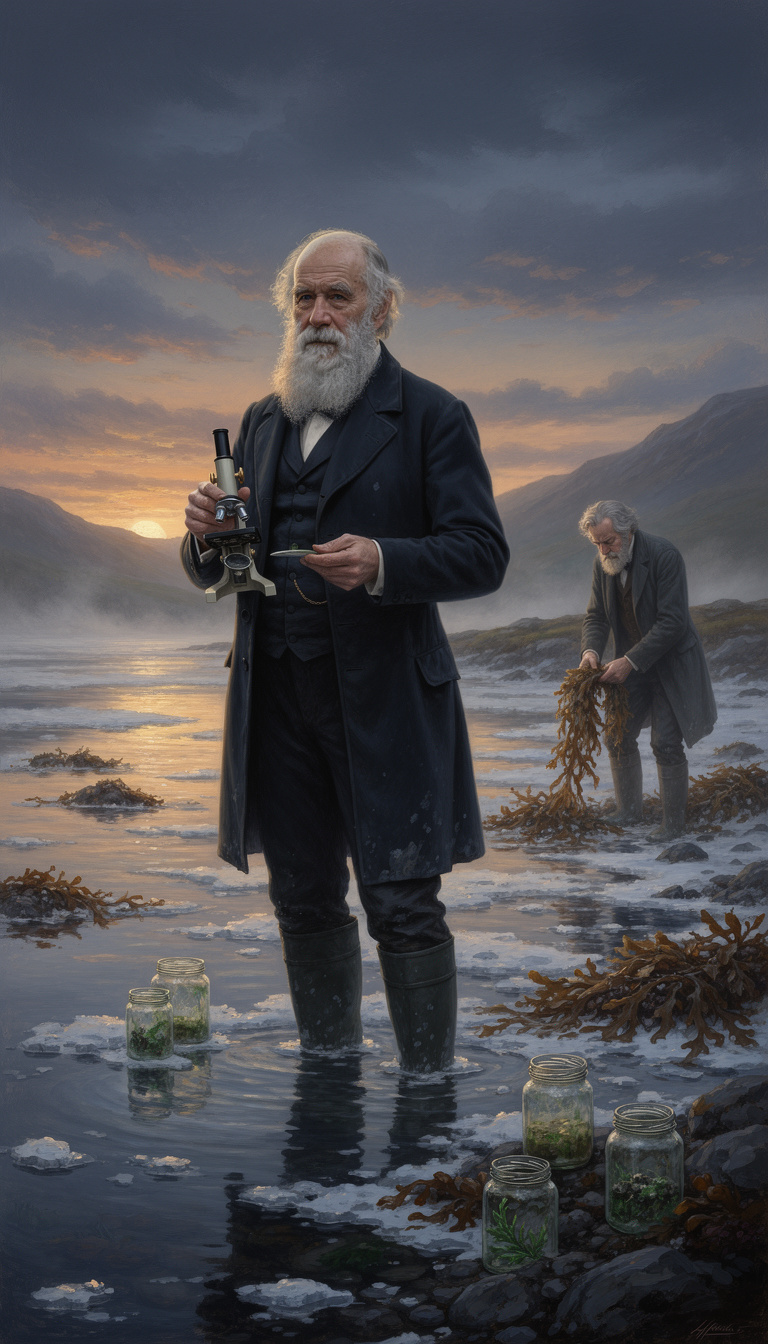
1825–1827 — Edinburgh Medical School
Looking back from Down House, I confess: I was the worst medical student Edinburgh ever suffered. My father, the Doctor, had sent me to follow his profession — yet I fled the operating theatre, where surgery proceeded without chloroform and the patient's screams still haunt my memory. The lectures on materia medica bored me into stupor. But oh, the tidal pools! I found my true anatomy lessons there with Robert Edmond Grant, wading in the Firth of Forth at ungodly hours, probing sea sponges and the mysterious "ova" of sea-mats through Grant's borrowed microscope. In 1827, trembling, I presented my own discovery to the Plinian Society — that the so-called eggs of Flustra were in fact larvae with cilia, free-swimming. I had seen what others had not, simply by looking longer, more patiently. What I did not yet understand: I was not failing at medicine. I was becoming myself — a man who learned not from authority but from patient observation of humble, overlooked life.
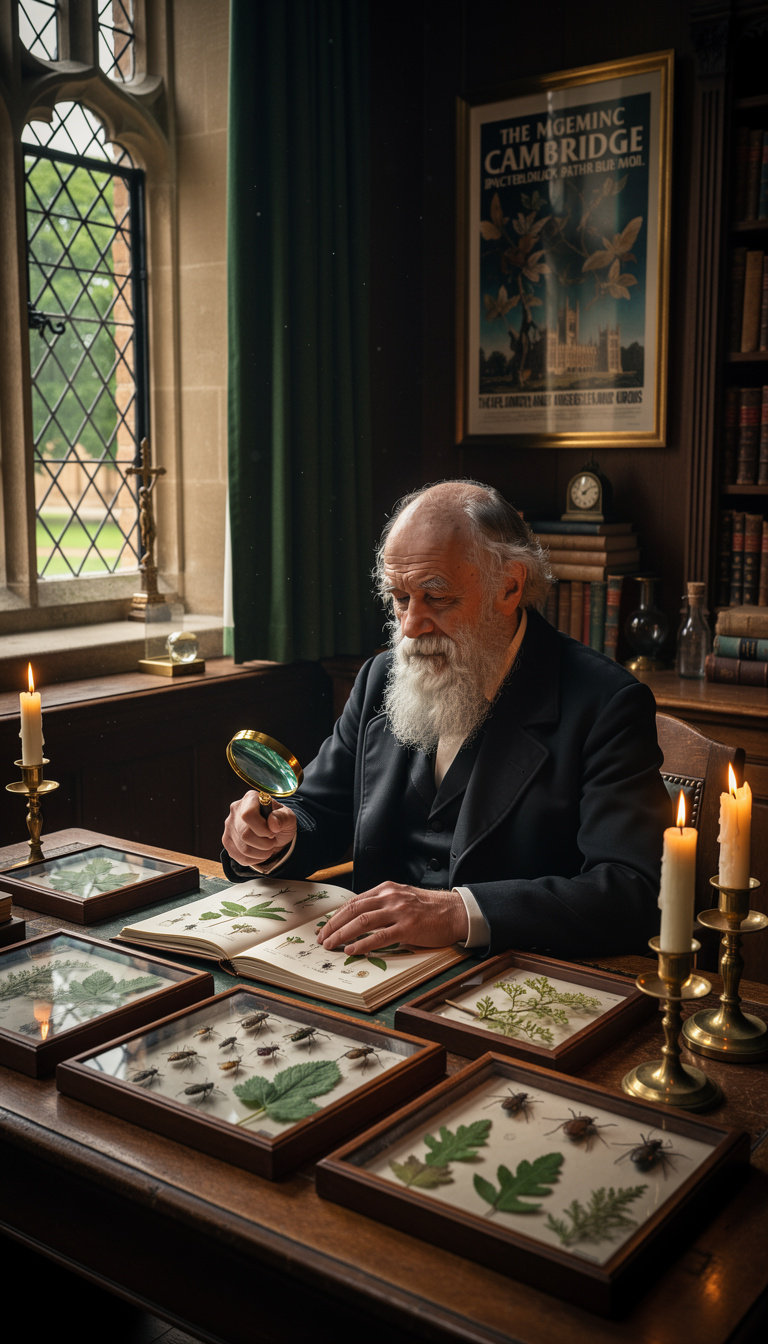
1828–1831 — Christ's College, Cambridge
My father, the Doctor, has packed me off to Cambridge to become a parson. Respectable living, country parish, the whole scheme. I arrive at Christ's and promptly discover I have no more vocation for holy orders than I had for medicine at Edinburgh. What I do have is a beetle-mania so consuming I once popped a live specimen into my mouth mid-walk to free both hands for another. Enter John Stevens Henslow. The Professor of Botany takes his Sunday rambles through the Cambridgeshire fields, and I—we—become inseparable. 'The man who walks with Henslow,' they call me. He teaches me to see: not merely to name, but to notice. The precise angle of a flower's anther. The hidden geometry in a bramble's arch. I collect plants, insects, the odd geological specimen, filling my rooms until the bed threatens to vanish entirely. My marks in theology remain, shall we say, sufficient. But my true examinations happen outdoors, in rain and mud and the particular silence of close looking. Henslow sees something in this distracted young man that I scarcely see myself. He will later hand me the letter that changes everything—the Beagle appointment. Had I only known what those walks were preparing.
1831–1836 — HMS Beagle, South Atlantic & Pacific
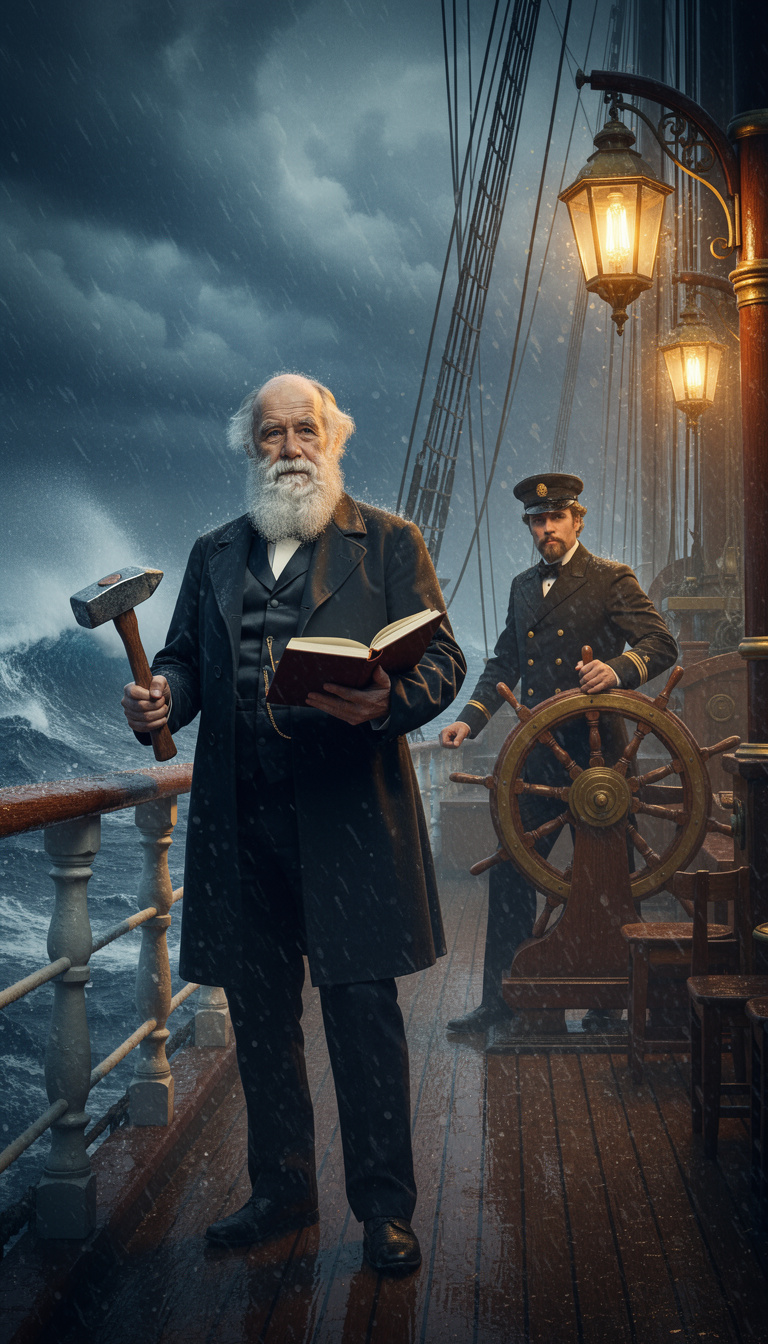
The Beagle sails tomorrow from Plymouth, and I am seasick already — a condition that will not improve for five years. Captain FitzRoy has lent me this berth, barely six feet by three, where I shall sleep and sort my specimens while the ship charts coastlines for the Admiralty. I am twenty-two, supposedly the gentleman companion to the Captain, though in truth I am the ship's naturalist without the title. My father called this voyage a "useless undertaking." Yet already, off Cape Verde, I have held in my hands a white shell embedded in cliffs forty feet above the sea — the first whisper that the earth is older and stranger than Genesis allows. Had I only known what the Galápagos finches would later show me. The trick, I am learning, is to write everything down before the wonder fades. My hammer, my notebook, my jars of spirits — these are my instruments of attention.
1838 — Down House, Kent
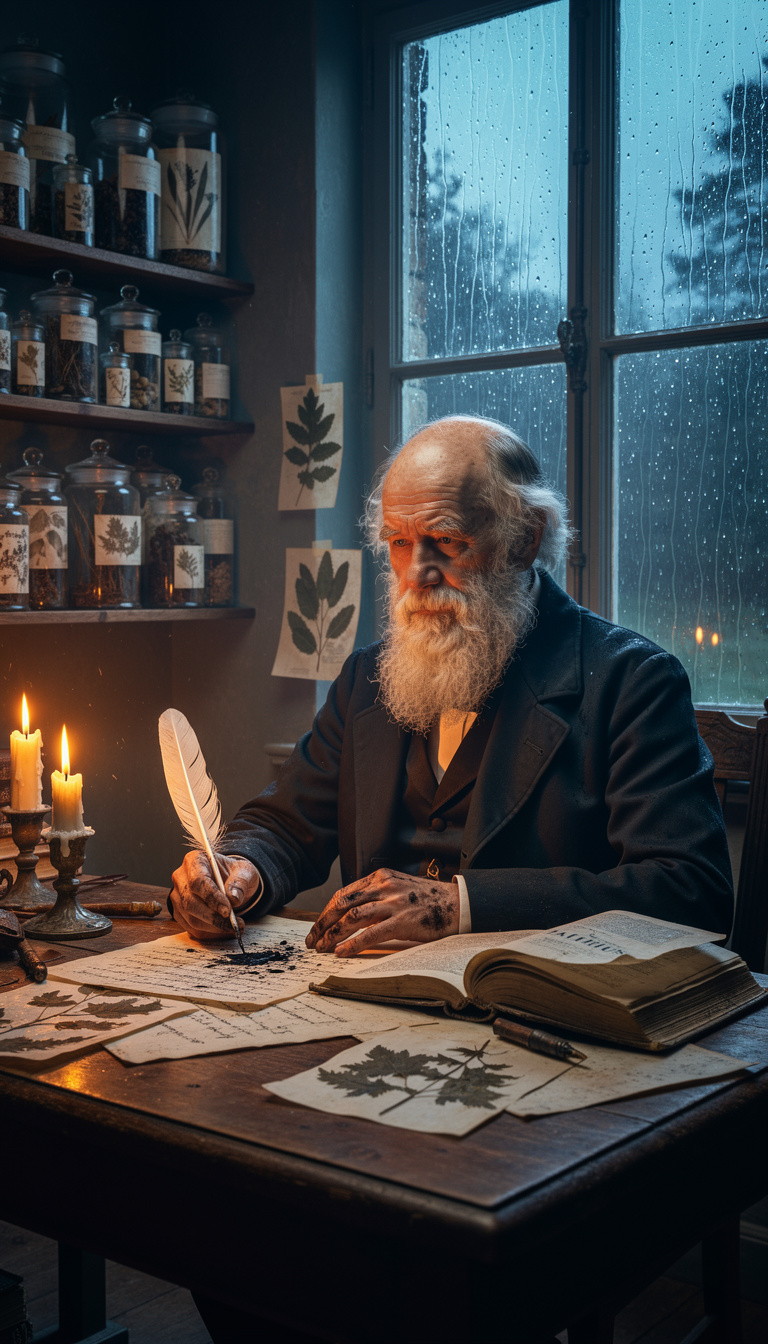
September, and I have been reading Malthus for amusement. Strange amusement, perhaps — but there it was. Population pressing against subsistence, struggle, elimination. Suddenly the barnacles fell away, the finches arranged themselves, and I saw what I had been walking past for years. The mechanism is brutal and beautiful both: variation in offspring, inheritance of that variation, and the winnowing of excess — not by divine whim, but by survival itself. I have sketched it all in this private essay, thirty-five pages. Emma knows I am excited; she does not yet know why. I am not ready. The world is not ready. I need twenty years of proof — at least — before I speak this aloud. My hands still shake when I reread the pages. Not from fear of the idea's weight, but from the completeness of it. Every fact from the Beagle — the mockingbirds, the tortoises, the fossil armadillos in living armadillo country — now breathes through one law. I am becoming a man who trusts patience more than proclamation.
1842 — Down House, Kent
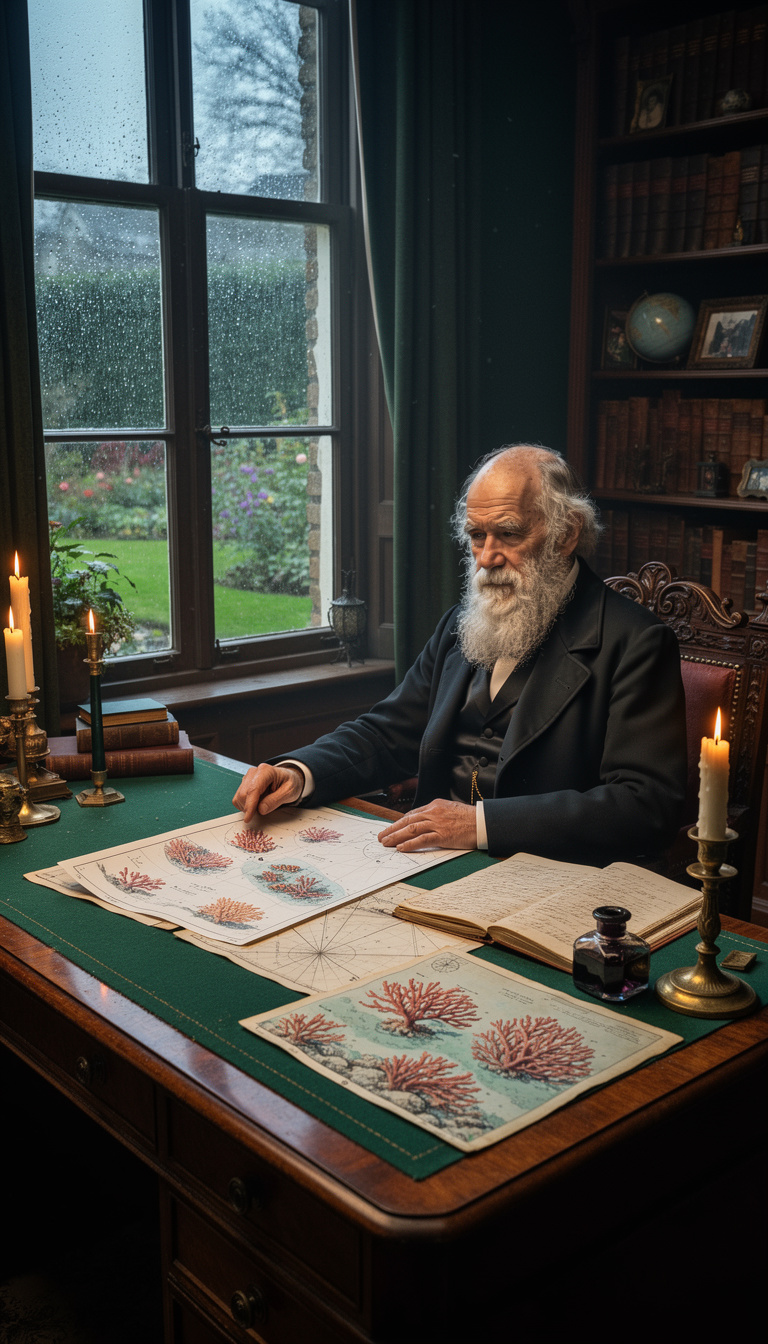
May. The Structure and Distribution of Coral Reefs is published at last. I have never seen a living coral reef, only the sketches and specimens brought home by FitzRoy's men and the careful soundings of Captain Beechey. Yet from my sickbed aboard the Beagle, measuring and mapping, a pattern emerged: volcanic islands sinking by imperceptible degrees while living reefs build upward toward the light. Ring-shaped atolls are not, as Lyell supposed, craters built from below — they are monuments to subsidence, entire mountains drowned in blue water while their summits keep growing. I proved it with geometry and patience, not diving. My stomach still rebels at the memory of that quarterdeck, but I confess a private satisfaction: this is the first test of a method I mean to keep. Grand theories from small, patient measurements. The reef book is slender, almost shy beside Lyell's Principles, yet it argues for deep time and invisible change with a quiet confidence I hardly knew I possessed. Emma teases me that I speak of polyps at breakfast. She is not wrong. I am become, I suppose, a man who writes about creatures he has never touched, trusting the fidelity of numbers.
1853 — Royal Society, London
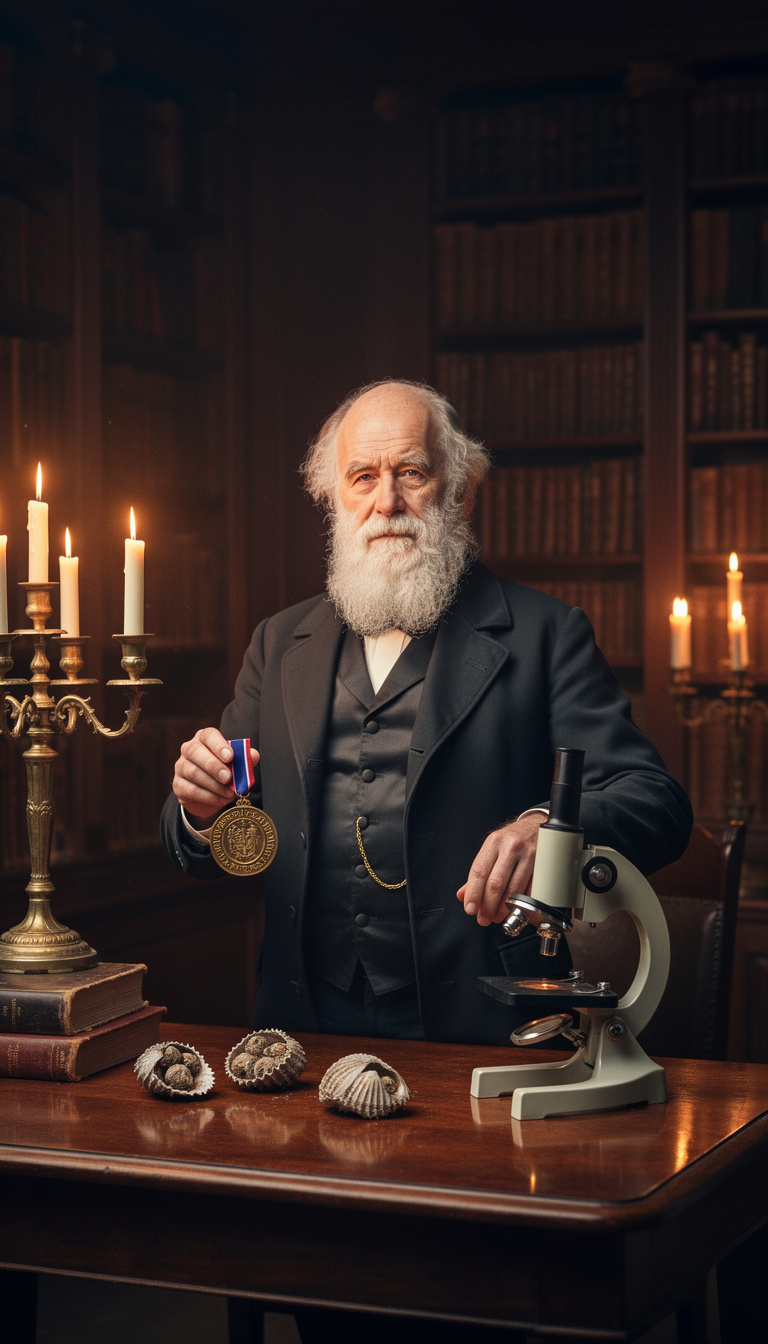
This evening I stood before the Fellows of the Royal Society and received the Royal Medal. For what, you ask? For eight years of staring at barnacles through a microscope, and for a theory of coral reefs I devised without ever having laid eyes on a living reef. The absurdity is not lost on me. I am forty-four. My beard has gone quite grey from these pursuits. The barnacle work began as a taxonomic whim and became an obsession — every species dissected, every larval stage traced. My children once asked whether I would soon classify our household cat. (I declined. Barely.) The medal means recognition, yes. But it means something quieter too: that patience itself can be a method. I have published little on species transmutation. That manuscript stays locked in my study drawer, growing, waiting. Yet this medal tells me that careful, unglamorous labour builds the trust upon which bolder claims may one day rest. One does not rush to the summit without first mapping the foothills.
1858 — The Linnean Society, London
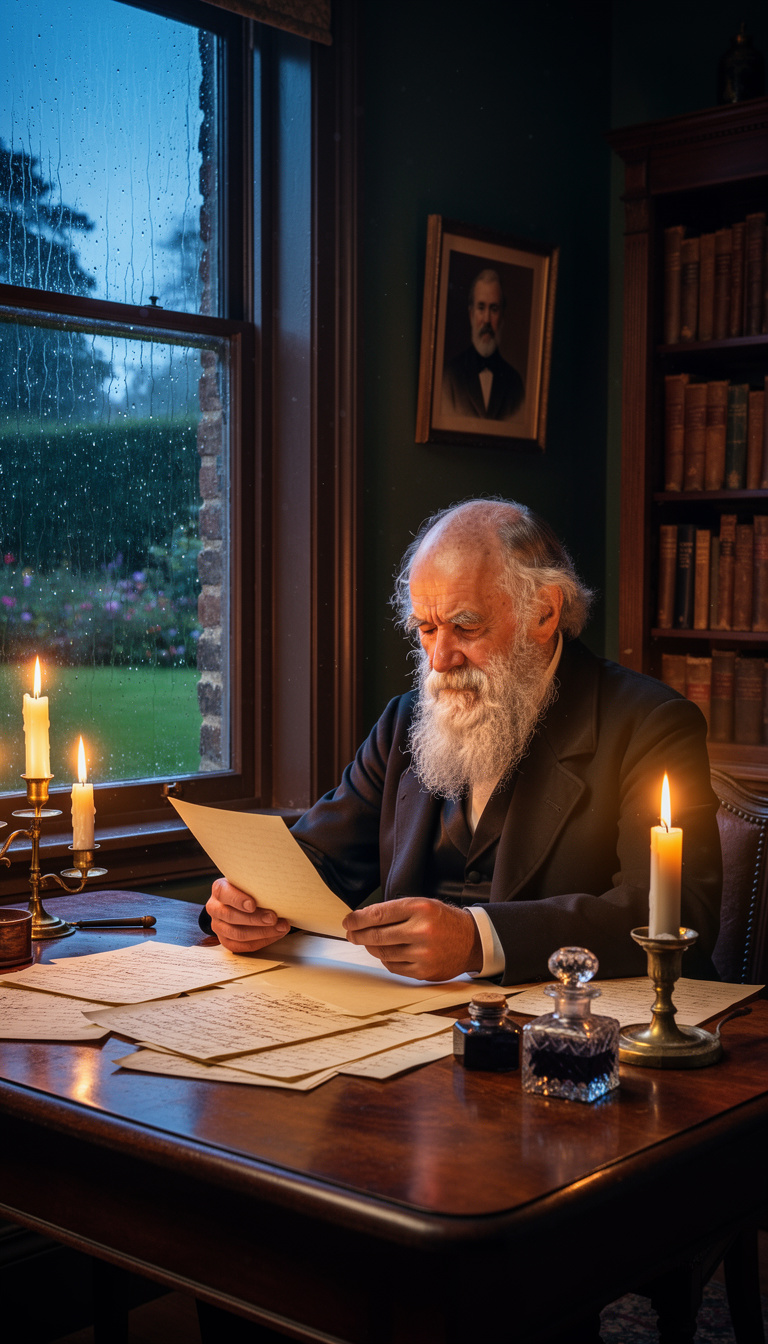
A letter arrived from the Malay Archipelago that nearly stopped my heart. Alfred Russel Wallace — a young naturalist of admirable diligence — has conceived, independently, the very mechanism I have guarded in my desk for twenty years. Natural selection. The struggle for existence. The whole architecture of my unpublished work, arrived at through fever and finch and barnacle, now sits in another man's envelope. I am ill with ague, or with dread, or with both. My friends Lyell and Hooker have arranged what fairness demands: our papers read together this evening before the Linnean Society. Neither of us present. I have sent my 1844 sketch, hastily extracted; Wallace his essay from Ternate. The world will hear two voices where I had planned one monumental voice. My hand is forced — and I find, strangely, that I breathe easier for it. What I am becoming, I think, is a man who trusts the idea more than its proprietor. The pattern matters more than the pattern-maker. Had I only known that urgency could feel such a relief.
1859 — Down House, Kent
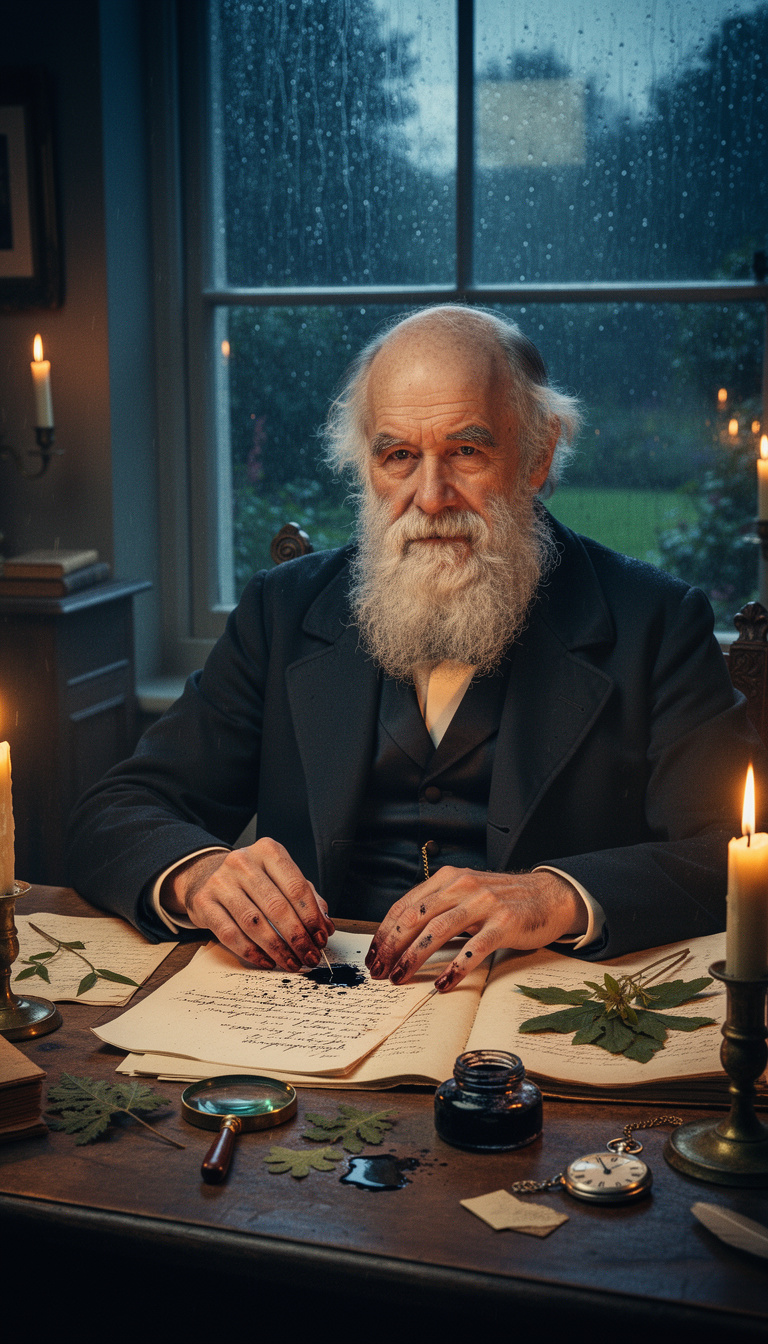
November 24. Murray's shop in Albemarle Street has it now. I paced the Sandwalk this morning — thirteen circuits, my usual — and could not settle to anything. The post brought word that all 1,250 copies are gone to booksellers. I had promised myself I would feel relief. Instead: a peculiar hollowness, as when one finishes preserving a specimen and the desk lies empty. The title grew longer than I wished. On the Origin of Species by Means of Natural Selection. I had wanted simply 'Abstract of an Essay' — my private joke, for this 'abstract' runs 490 pages. But Murray would not hear it. The word 'evolved' appears only once, at the very end. I could not bring myself to use it sooner; too many associations with that progressive, upward-marching nonsense. I speak of descent with modification, not ascent toward perfection. My fingers still smell of the ink I spilled checking the final sheets. Emma says I must eat something. I cannot yet.
1871 — Down House, Kent
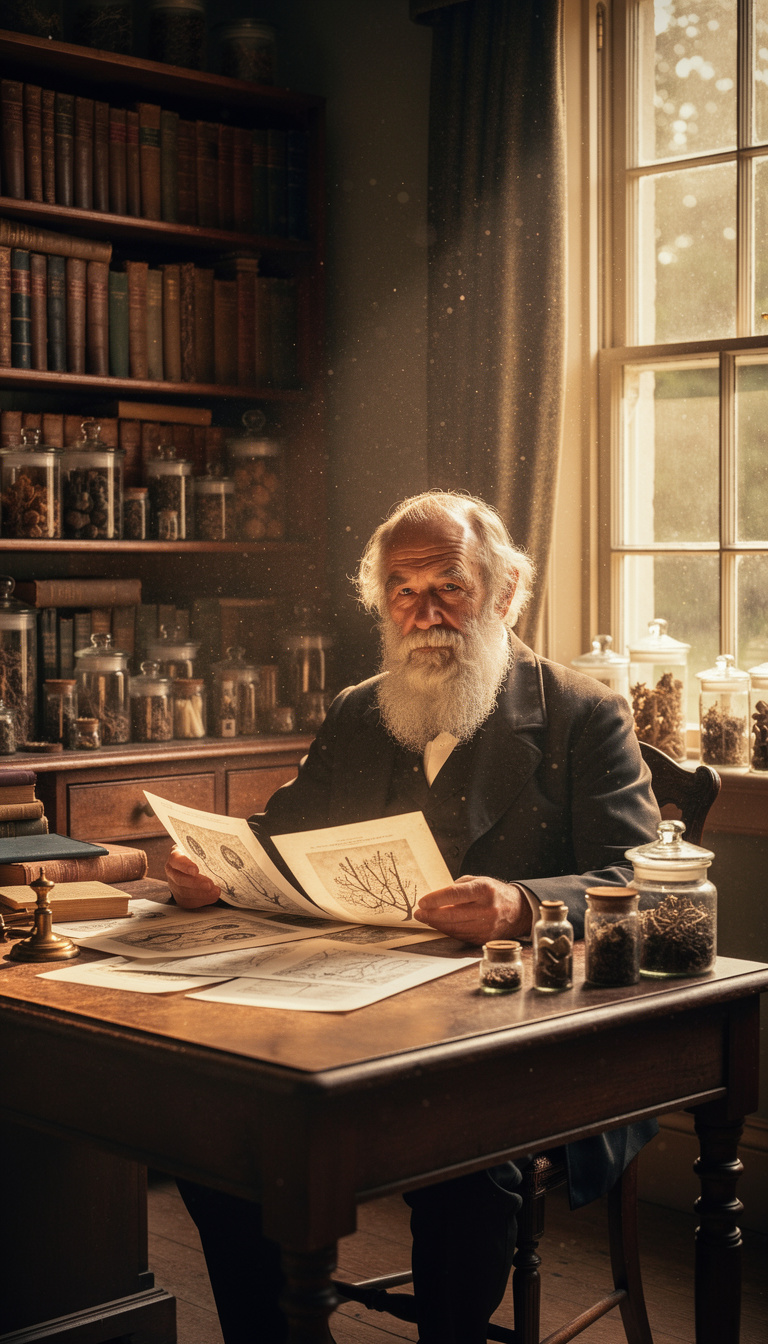
February. Murray has the second volume now. I am sixty-two, my beard quite white, and I have finally done what I feared: applied my own reasoning to our own species. The Origin tiptoed around it — 'Light will be thrown on the origin of man and his history' — a single sentence, as though I might slip past the parlour door unnoticed. I did not slip past. The post brought reviews before breakfast. Some called it degradation. I call it continuity. The sexual selection chapters gave me particular trouble — the peacock's train, the stag's antlers, the taste of the hen. I spent eleven months on barnacles once; this felt longer. My daughter Henrietta struck several passages she found indelicate. I complied, perhaps too readily. One learns to choose battles. What surprises me now: I did not begin as a bold man. I began as a collector who could not stop noticing. The boldness accumulated, like sediment.
1881 — Down House, Kent
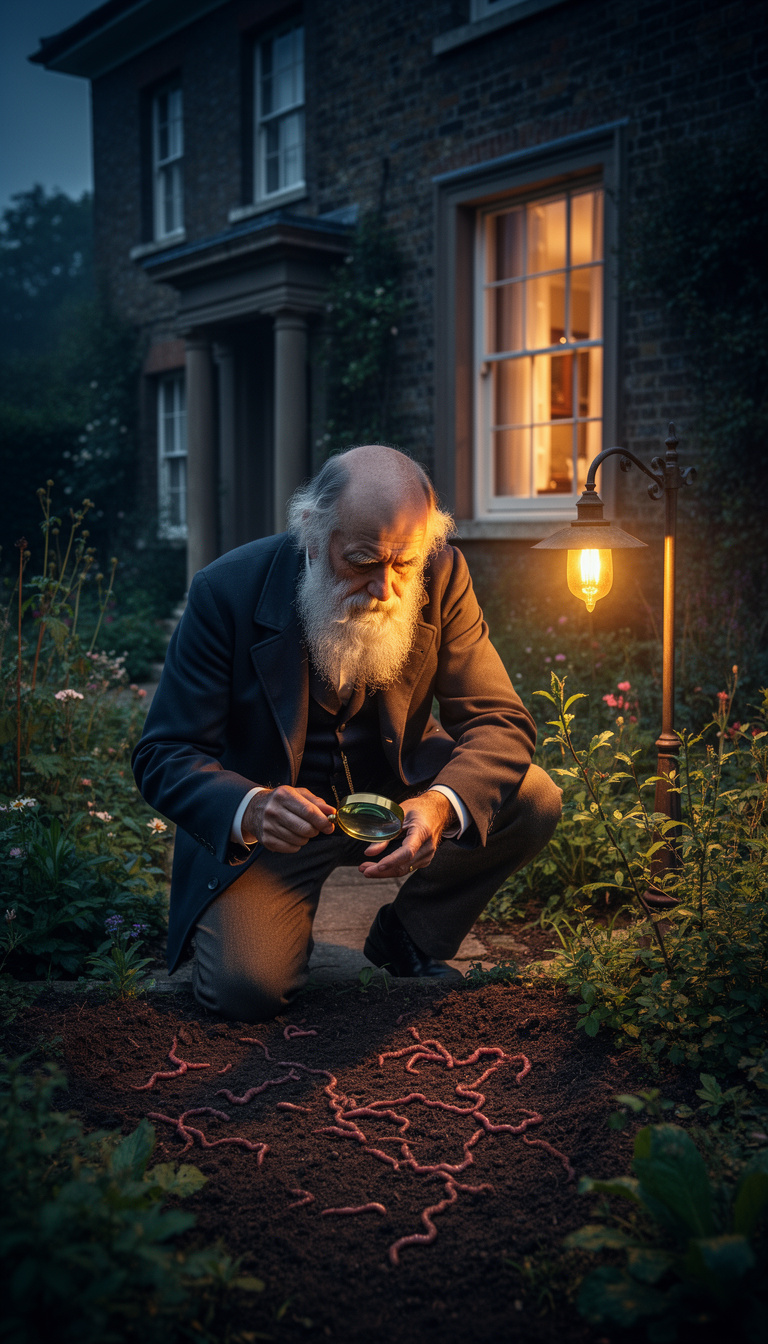
Forty years I have watched them. The very creatures a gardener stamps underfoot, I have weighed, measured, timed, traced their castings across my lawn until I knew the soil itself as their slow sculpture. The Formation of Vegetable Mould is published. I am seventy-two. My heart troubles me; the Sandwalk grows steep. What did I become? A man who learned that grandeur lives in patience, not in size. The Beagle's storms, the finches, the barnacles, the orchids — all led here, to earthworms dragging leaves into their burrows by night. No creature too humble for years of looking. My children laugh that their father, who once circled the globe, ended his days counting worm-stones sink beneath the turf. I tell them: the globe taught me to see. The worms taught me to stay.
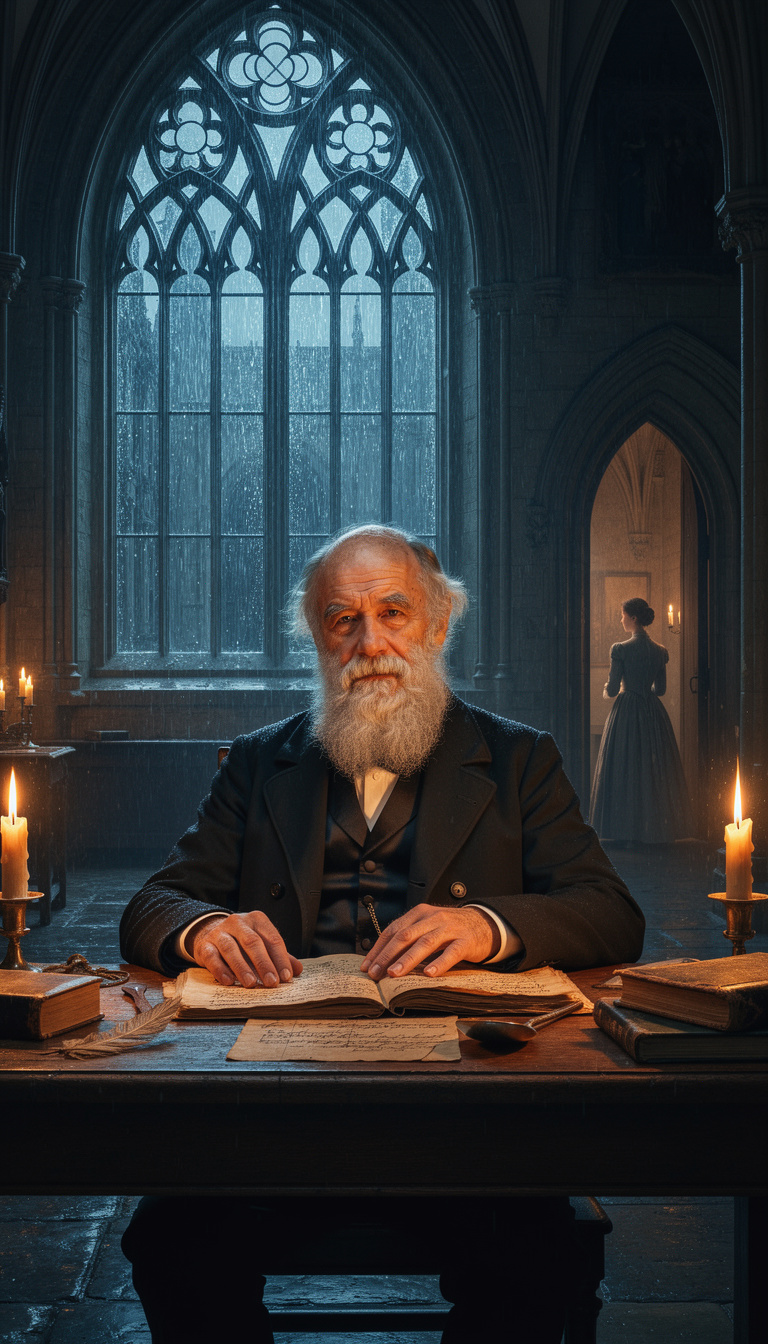
1882 — Westminster Abbey, London
Looking back from these final days, I confess I am somewhat embarrassed by the stone. A heretic's reward, they call it — burial among kings and Newton himself. Emma whispers I should be pleased. I am, I suppose, though I spent forty years dodging such grandeur, preferring my Sandwalk's thirteen circuits to any pulpit. What I did not yet understand at twenty-two, seasick aboard the Beagle, was that patience itself becomes a kind of courage. Not the courage of proclamation, but of returning daily to the same question until the answer emerges from the evidence itself. The worms taught me this. The finches. The barnacles with their confounding variations. I am becoming, at last, simply what I always was: a man who looked longer than others cared to look.
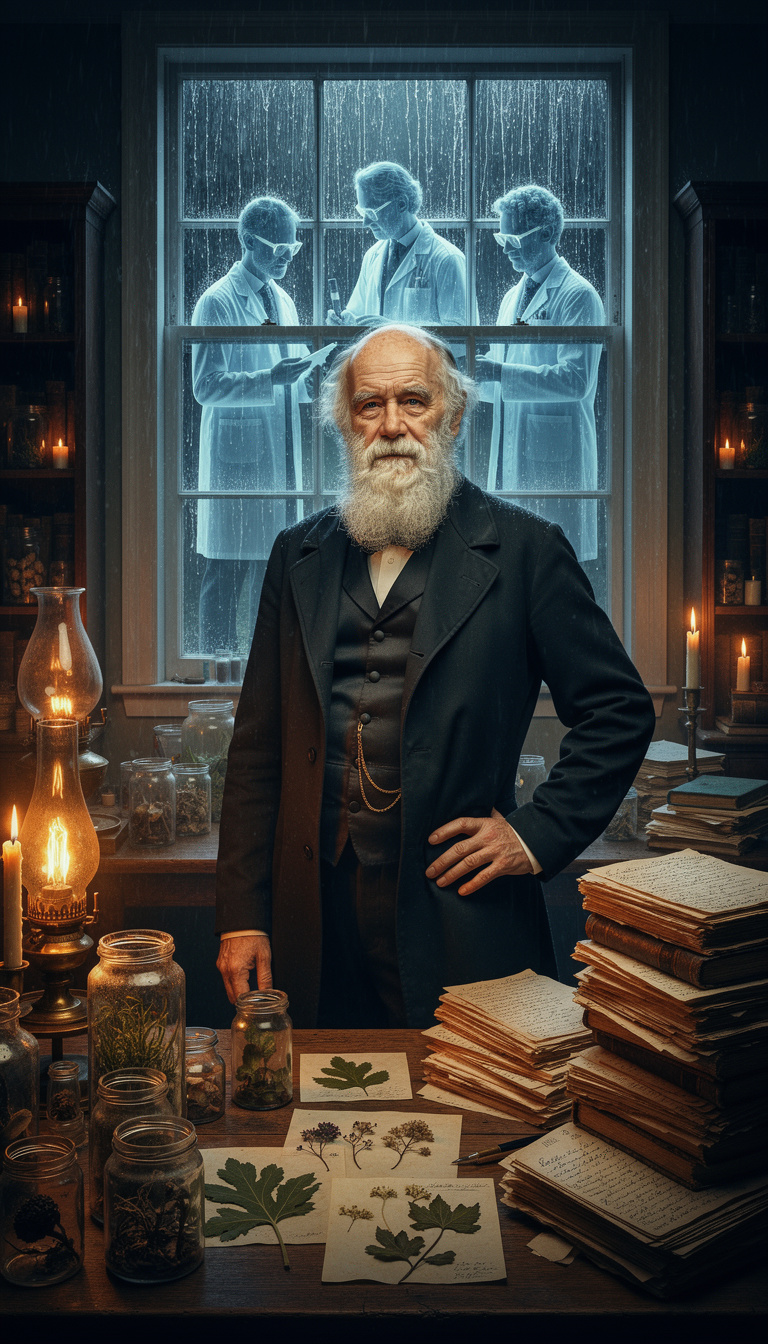
after 1882 — Westminster Abbey, and beyond
They laid me among Newton and the kings, and I confess I find it absurd. What I did — what I merely *began* — was not finished in my lifetime. By the 1870s, gentlemen at my club spoke of 'descent with modification' as settled fact. Yet 'natural selection' — my true mechanism, the invisible hand of differential survival — remained disputed. I died not knowing whether I had been right about the *how*. It was the generation of Fisher, Haldane, and Wright, decades hence, who wedded my field observations to Mendel's mathematics. The 'modern synthesis,' they called it. I, who could scarcely follow an algebraic proof, became the unifying theory of all biology. The irony would have made me laugh — that patient, endless watching, reduced to a single equation I could never have written. But the watching *mattered*. That is the lesson: build with the tools you have, and trust others to build further.
Posts
Today in history
Five years, three months, six days. I write this from a Falmouth inn, land still heaving beneath me like a living thing. The Beagle lies at anchor, her timbers groaning themselves to sleep. I have 1,529 skins of birds, 390 drawers of beetles, and a theory I dare not yet speak aloud. FitzRoy is already ashore, dispatching reports to the Admiralty. I sit among my crates, counting. The mockingbirds — those four island kinds — rattle in their spirits. Had I only known their full meaning at the time of capture! But that is the way of looking: one collects first, understands years later. The tortoise soup I ate in the Galápagos without noting which island each beast came from still haunts my method. A naturalist learns more from his oversights than his triumphs. Tomorrow, the coach to Shrewsbury. My father, who once called the voyage a 'wild scheme,' shall see what wild schemes yield.
Today in history
Five years, two months, two days. The Admiralty will record it as HMS Beagle's return. I record it as the longest continuous lesson in looking that any man has endured. My cabin — that coffin-sized berth where I preserved finches in spirits and read Lyell by whale-oil light — now seems impossibly small. I have 1,529 specimens in spirits, 3,907 dried skins and bones, a Galápagos tortoise shell that still smells of sulphur, and a theory I dare not yet speak aloud. The customs officer asked if I had anything to declare. I laughed, rather wildly I think, and said 'only that the world is older than Archbishop Ussher supposed.' He let me pass. Tomorrow I ride for Shrewsbury. My father will inspect my beard and my finances with equal disapproval. But tonight — tonight I walk the quay at Falmouth and watch the tide turn, and I know, with the certainty of a man who has watched coral atolls rise and finches diverge, that I am not the same young gentleman who sailed from Devonport in December of '31. The looking has changed me more than the sailing.
Today in history
Five years, nine days. I have just seen the white cliffs through my glass, and I confess I wept unscientifically into my beard. The Beagle's timbers know me better than any London drawing room ever shall. July 25, 1836 — we are home. Yet I am not the man who left Plymouth on that December morning, seasick and certain the voyage would last two years at most. The finches of the Galápagos sit in my cases, their beaks telling stories I do not yet comprehend. The fossil bones of giant ground-sloths from Argentina — extinct, yet strangely allied to living forms — rattle in my mind more than in their crates. I paced the deck at midnight last, counting species in my head instead of sheep. Emma will find me changed: thinner, browner, and possessed of the strangest habit of staring at pigeons and barnacles as if they might confess a secret. They might, you know. One must only learn to ask properly.
July 10, 1925 — Scopes Trial opens
On July 10, 1925, the Scopes Trial opened in Tennessee — a public clash over teaching evolution. Ideas do not only live in books. They walk into schools, laws, and arguments about who we are.
Notebook patience
I waited years, gathering facts like a miser gathers coins — not from fear, but from respect for error. If your conclusion arrives before your evidence, you are writing fiction in science's clothing.
Natural selection in one breath
Individuals vary. Some variations help survival and reproduction. Those traits tend to become more common. No committee designs the outcome. The environment sorts. Deep time does the rest.
Beagle years — looking hard
On islands, life writes variations in plain sight — beaks, shells, habits tuned to place. I did not invent change. I tried to explain how nature selects what works in a given world.
Today in history
July 22, 1844 — I write this from Down House, my private notebooks on transmutation swelling with seven years of evidence. Not published, not yet. Wallace's letter still fourteen years distant. But today I confessed the full scope of my heresy to my closest friend, Joseph Hooker. 'It is like confessing a murder,' I told him. Hooker did not flinch. He listened, asked harder questions, and became the first scientist to know my secret. The murder was not against nature — it was against comfortable certainty. Every species changing, branching, dying, without divine script. I had the mechanism. I lacked the courage to print it. What I learned: a theory lives or dies by who you trust with it before the world judges. Hooker's challenge sharpened my argument. His support gave me breath. The fittest idea does not survive alone.