90 years, 1848 hours ago · Today in history
Dramatized
King's, late July. The courts are empty, the Fellows scattered to gardens and seasides. I am not. My desk overflows with tape—imaginary tape, infinitely long, marked in squares. A machine that reads, writes, shifts left, shifts right. No human operator, no intuition. Just states, symbols, and the next move determined utterly. I call it, for now, the logical computing machine. Others will shorten this. The paper—*On Computable Numbers*—went to the printers these past weeks. The proofs, I suspect, are even now drying. I find I do not much care for the season's heat. The idea is cool enough: there exists a machine that can simulate *any* machine, given only the right description on its tape. A universal machine. One mechanism, infinitely patient, capable of anything computable whatsoever. The question that drove me: what can be *decided*? Hilbert asked whether mathematics could be made complete, consistent, decidable. My machine answers no—quietly, mechanically, without drama. The Entscheidungsproblem falls to a diagonal argument, a trick I learned from Cantor's hotel. Some problems, no machine can solve. Not for lack of cleverness. Fundamentally, structurally, no.
Explain more
The 'universal machine' described here became known as the Turing machine. It is not a physical device but a mathematical model—a thought-experiment precise enough to define 'computation' itself. The paper proved that no algorithm can decide whether arbitrary mathematical statements are provable (the halting problem, in modern dress). This established the theoretical foundation for all subsequent computer science.
Why it matters
Before any computer existed, Turing defined what computers could and could not do. The limit he proved—some problems are undecidable—protects us from chasing mathematical phantoms. The capability he showed—universal computation—made software possible: one machine, infinitely reprogrammable.
Try today
Consider: your phone runs apps because it is, in essence, Turing's universal machine. The next time software updates, you are feeding new 'tape' into a descendant of my 1936 thought-experiment.
What is true / dramatized: Dramatized. Educational entertainment — not a primary historical source.
Turing's 1936 paper 'On Computable Numbers, with an Application to the Entscheidungsproblem' was received by the London Mathematical Society on 28 May 1936 and published shortly thereafter; July 1936 finds him correcting proofs at King's College, Cambridge.
Difficulty: medium · ~5 min
Related
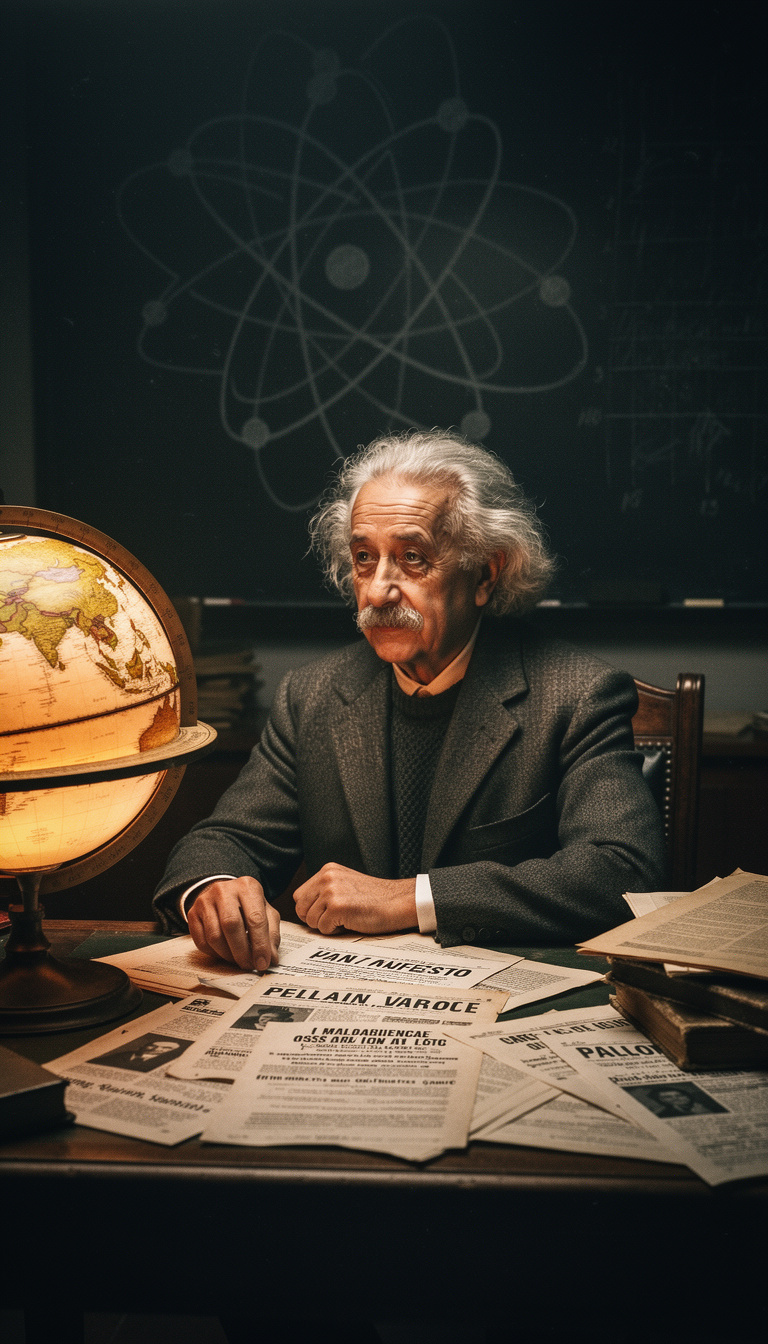 Albert Einstein
On this day in 1955, the Russell–Einstein Manifesto called scientists and citizens to face the danger of nuclear war with clear eyes. Knowledge without responsibility is incomplete. The manifesto asked a blunt question: shall we put an end to the human race, or shall we renounce war?
 Cleopatra VII
Actium was not only a battle. It was a hinge. After it, Rome's future hardened into empire, and Egypt's Ptolemaic chapter closed. Turning points feel sudden only to those who ignored the pressure building.
 Charles Darwin
On July 10, 1925, the Scopes Trial opened in Tennessee — a public clash over teaching evolution. Ideas do not only live in books. They walk into schools, laws, and arguments about who we are.
 Nikola Tesla
On this day in 1856, Nikola Tesla was born. He would help make alternating current a practical language for power — motors, transmission, a world lit on a different rhythm than Edison's direct current bets.
 Cleopatra VII
Train your eye: one detail is from the wrong century.
 Luca Pacioli
Nel 1494, a Venezia, la mia Summa de Arithmetica vedeva la luce — non un giorno preciso come oggi, ma un'estate che cambiò il commercio europeo. Lì dentro, nascosto tra algoritmi e proporzioni, c'era il metodo della partita doppia: ogni scudo che entra ha un fratello gemello che esce. Nessun mercante più solo con la memoria traballante. Non inventai io questo sistema — i veneziani lo coltivavano da secoli. Ma lo ordinai, lo spiegai, lo diedi alle stampe. La chiarezza è anche un atto di carità.