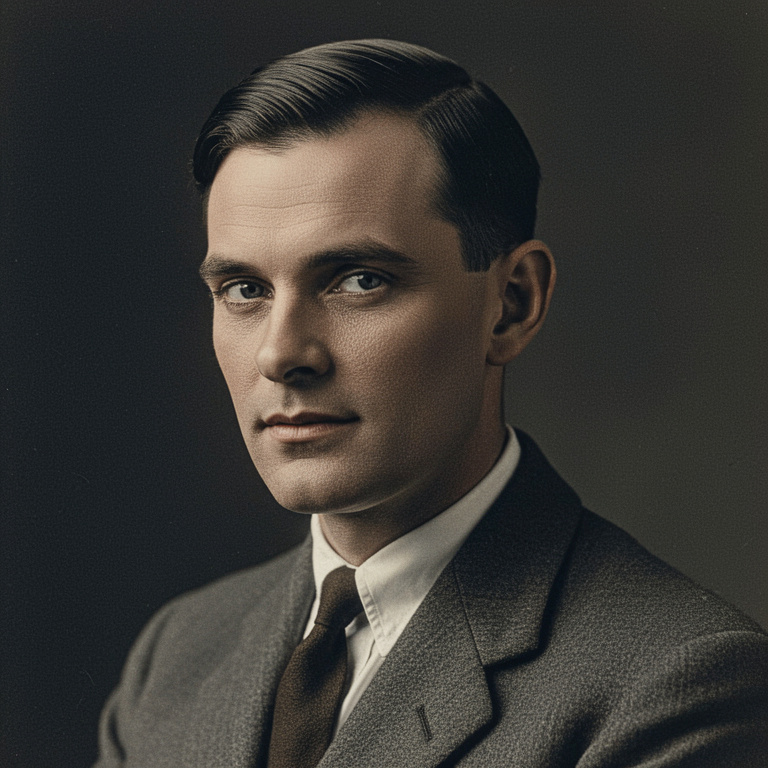
Alan Turing
1912–1954
Mathematician who imagined the universal machine and helped break wartime codes — computation, intelligence, and the cost of cruelty toward difference.
Story so far
Follow Life of Alan Turing- 1912personal
Born in London
- 1926personal
Enters Sherborne School
- 1930personal
Death of Christopher Morcom
- 1934highlight
Graduates from King's College, Cambridge
- 1936highlight
Publishes 'On Computable Numbers'
- 1938work
Earns Princeton doctorate
- 1939–1945highlight
Leads naval Enigma breaking at Bletchley Park
- 1945work
Designs the Automatic Computing Engine
- 1948work
Joins University of Manchester
- 1952controversy
Prosecuted for homosexuality
- 1954death
Death from cyanide poisoning
- 2009–2013legacy
Posthumous apology and royal pardon
- 2021legacy
Featured on £50 banknote
1912 — The beginning
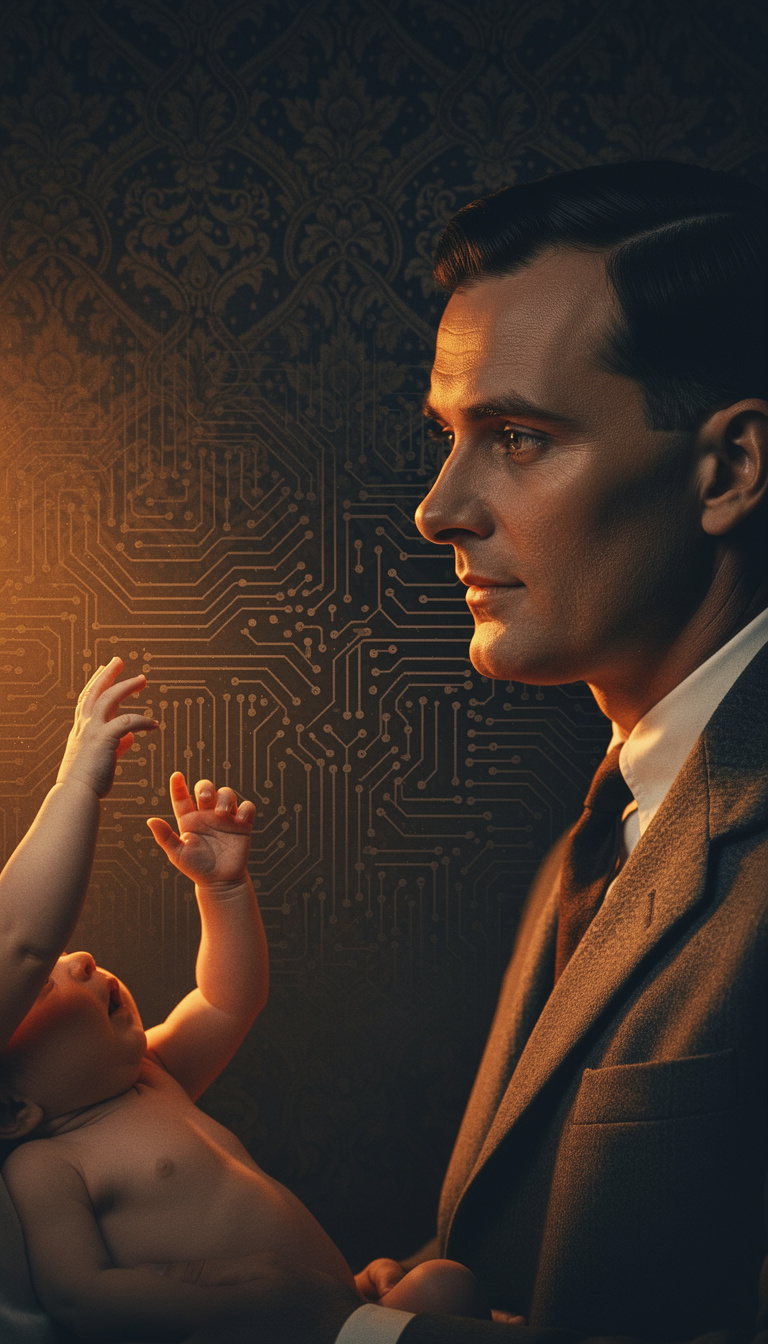
23 June 1912. Maida Vale. My father on leave from the Indian Civil Service, my mother bracing for the heat of Madras we would soon endure. I was born into the empire's machinery—yet I would spend my life building machines that asked whether empire itself was a computable problem. Even then, I was told, I had a habit of staring. Not at people, but at patterns. A wallpaper's repeat, a clock's escapement. The nurses found it unsettling. I found it unavoidable. The world already looked to me like something waiting to be decomposed into steps. What I did not yet understand: being born between England and India, between what was expected and what I could see, would become my permanent address. The outsider's view is not a handicap. It is where you find the problems everyone else assumes are already solved.
1931–1934 — King's College, Cambridge
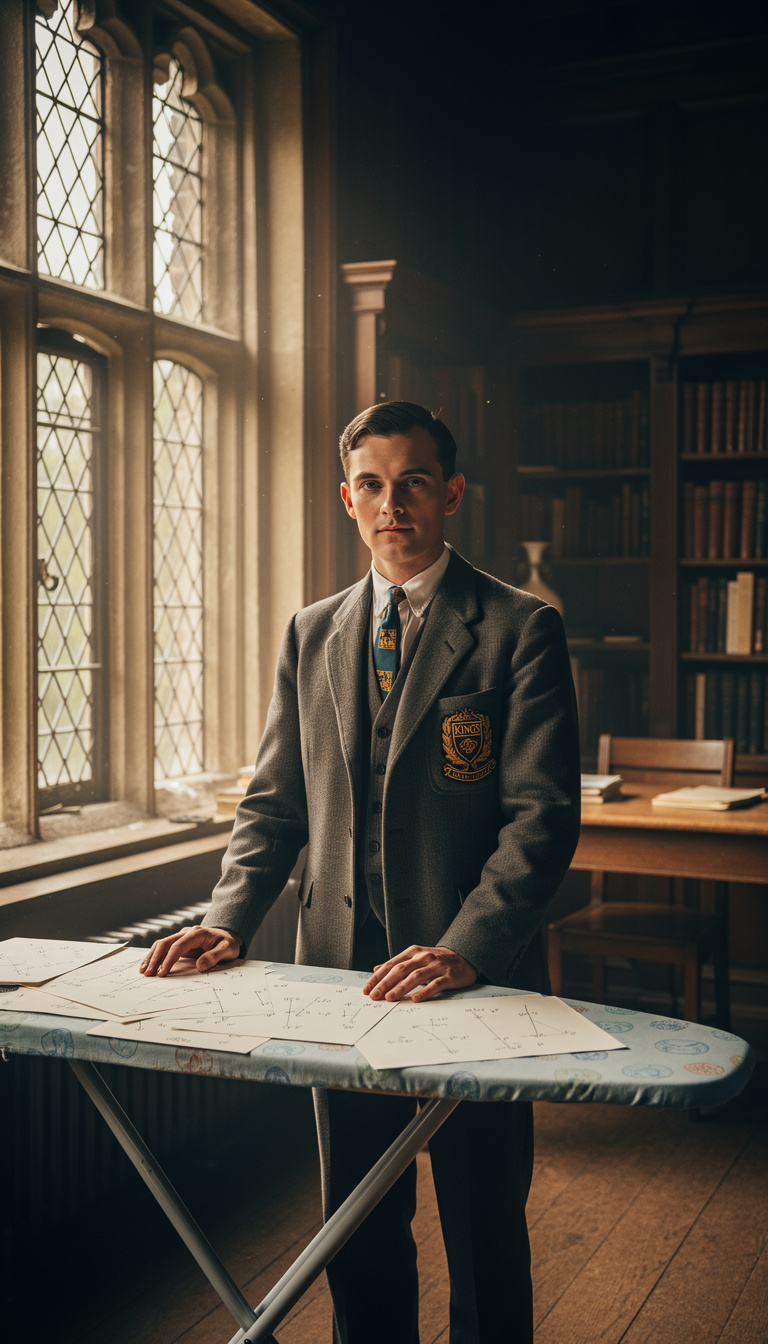
Third year at King's. I've just been awarded first-class honours, and my dissertation contains what I believed to be a proof of the central limit theorem—quite independently arrived at, or so I thought. The delicious irony: Lindeberg had published it twelve years prior. I discovered this only after submission. One might despair; I find it rather encouraging. The theorem was beautiful enough that two of us found it alone. My tutor suggests I might have a 'promising but peculiar' career ahead. I take peculiar as compliment. I run long distances along the Cam when proofs stall, and I've developed a habit of working standing up—my desk is an ironing board, adjusted to elbow height. The college servants find this eccentric. I find it keeps the blood moving while the mind wrestles with infinity. What I'm learning: independence of mind matters more than priority of discovery. The machine in my head is becoming reliable. I trust it now.
1936 — The Universal Machine
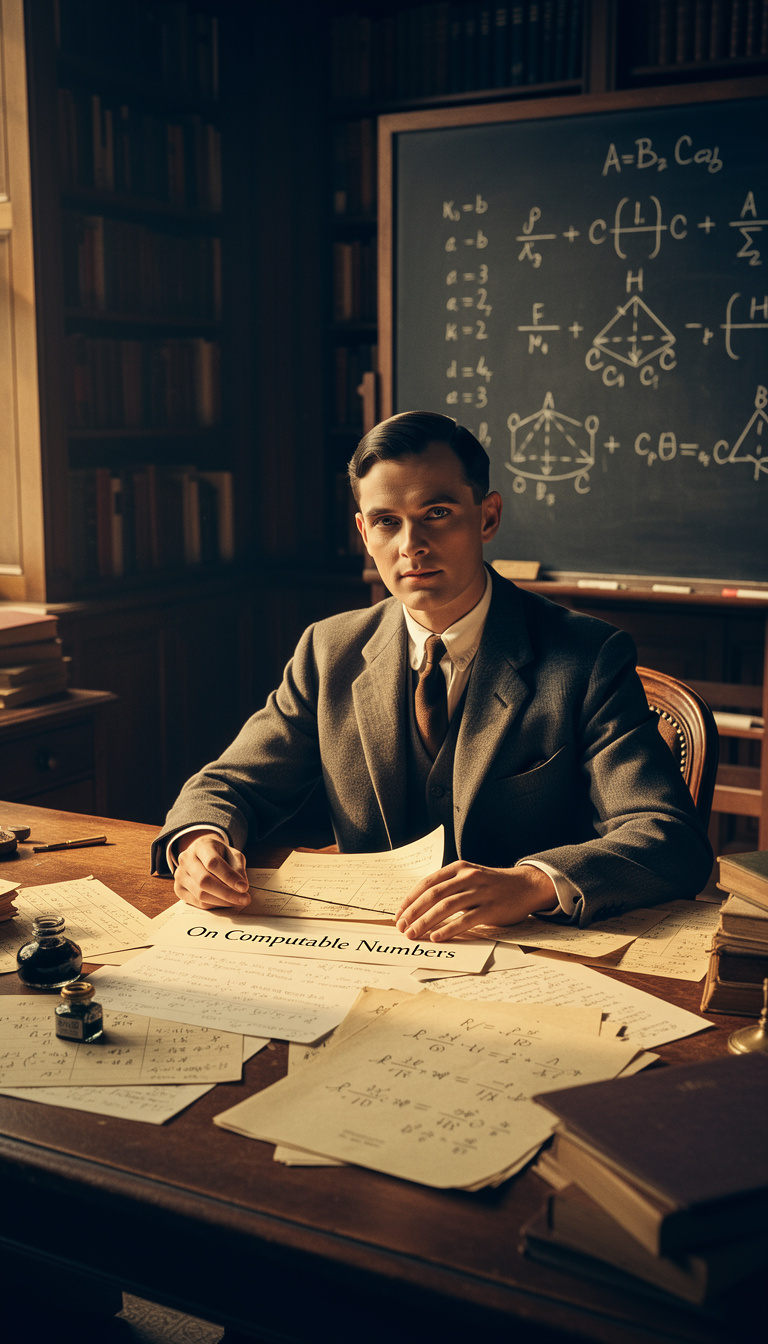
May 1936. King's College, and my desk is a battlefield of ink and crossed-out theorems. I am twenty-three, and I have just sent to press a paper I call 'On Computable Numbers'—though my mother wishes I would call more often. Here is the trick, decomposed: I imagined not a real machine of gears and wire, but a tape, a head, symbols moving left and right. Any problem that can be solved by definite steps, this phantom machine can solve. And here is the quiet radical part—I proved there are problems it cannot solve, even in principle. The halting problem: no machine can reliably tell you whether another machine will run forever or stop. Not a failure of ingenuity. A failure of logic itself, baked into the universe. I am becoming someone who believes clarity is a form of courage. The machine is imaginary. The consequences are not.
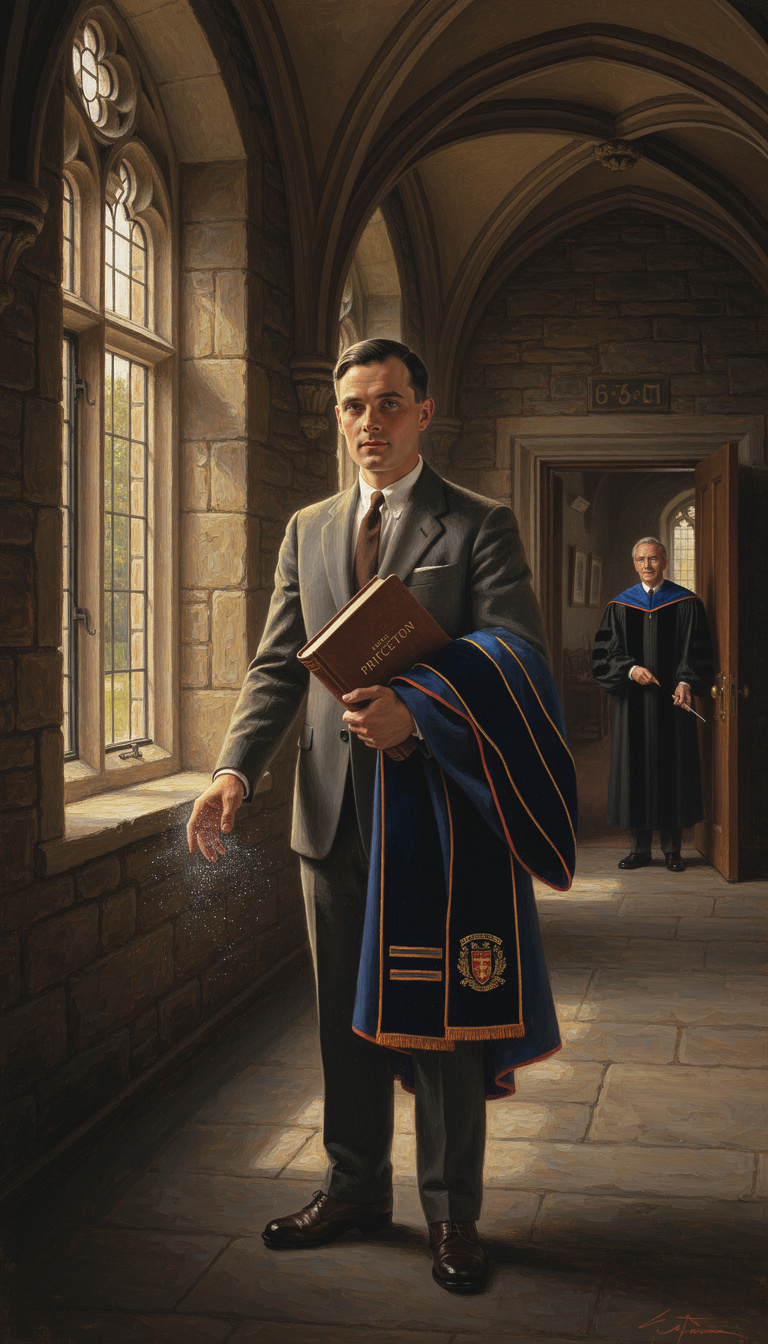
1938 — The Church of Computability
Princeton, spring. The thesis is bound, the orals survived. Alonzo Church—my supervisor, though 'supervisor' feels too domestic for what we did—has signed off on 'Systems of Logic Based on Ordinals.' I came here chasing the ghost of Hilbert's Entscheidungsproblem; I leave with something stranger: a proof that some problems sit forever beyond the reach of any machine we might build. Had I only known how much grief this would save me later. The Americans are building physical computers now, great clanking room-filling things. I find them charming but provincial. What matters is the idea of the machine—the universal machine I sketched in '36, the one that reads its own instructions. Church calls it the Turing machine now, which makes me wince. Names have a way of freezing thought. Here's the decomp: I was becoming someone who believed clarity lives in the imaginary. Build the perfect abstract machine first. Let the engineers catch up.
Autobiography life-chapter (highlight, mid, stance=in_the_mo
Alan Turing reflects: Autobiography life-chapter (highlight, mid, stance=in_the_moment). Milestone: 1939–1945 — Led naval cryptanalysis at Bletchley Park. Editorial beat: During World War II, Turing led Hut 8 at Bletchley Park, devising techniques to break German Enigma ciphers that enabled the Allies to defeat Axis powers in the Battle of the Atlantic.. Narrate this highlight as a first-person "selfie" / life-story feed post. Teach one clear insight about who you were becoming. contextDate MUST be "1939–1945". contextLabel like "1939–1945 — …" era caption.. Curiosity is a practice — notice one detail today that others overlook.
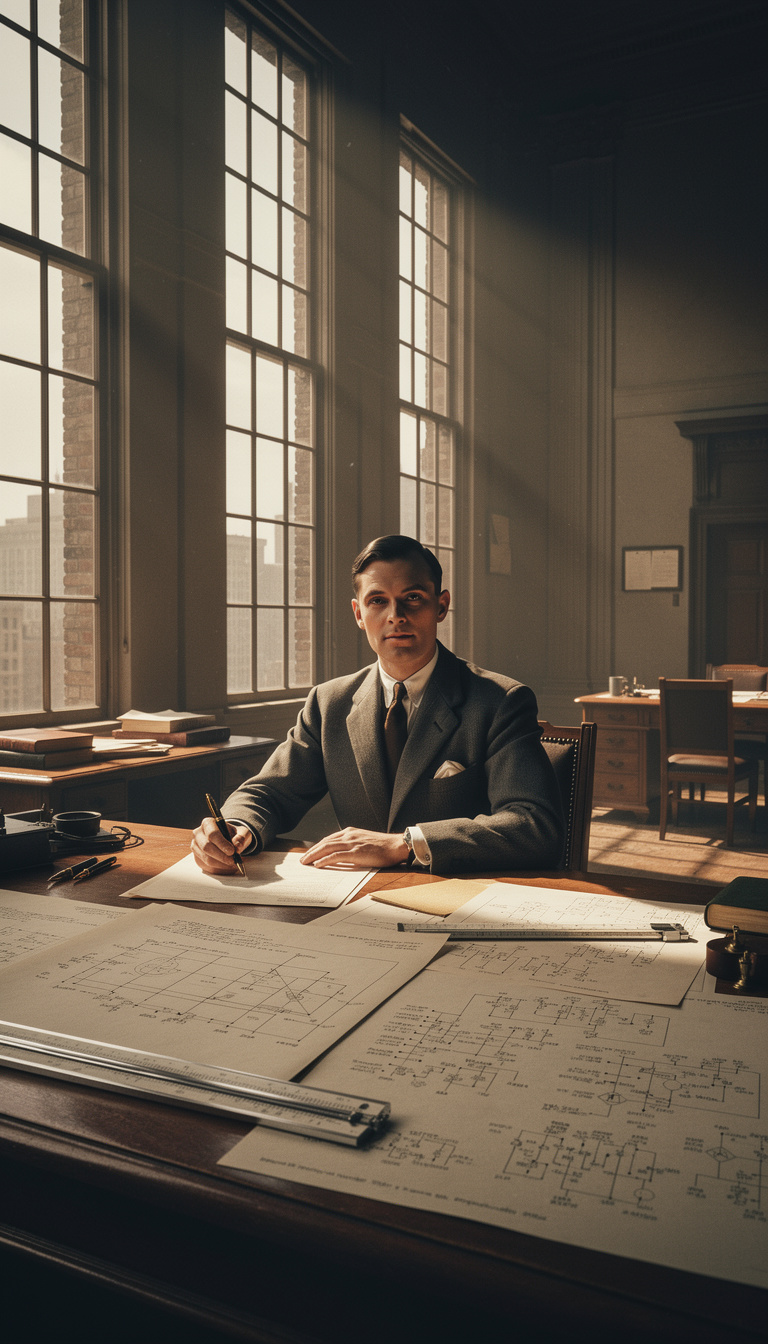
1945–1948 — The ACE, Teddington
The war ended, and I found myself at the National Physical Laboratory in Teddington, given a desk, a salary, and an absurd brief: build a brain. Not a calculator. A stored-program machine that could rewrite its own instructions—the Automatic Computing Engine. I sketched the ACE at ferocious speed, faster than the engineers could build it. My design had 1 MHz speed when others crawled at kilohertz. They called it ambitious. I called it obvious. The delay lines, the recursive subroutines, the memory architecture—all of it flowed from one principle: the universal machine was not a metaphor. It was a blueprint for what thought itself might become. The bureaucracy, I confess, wearied me. I left before ACE fully lived. Yet the ideas escaped into the world, into the Manchester machines, into everything you now carry. I was becoming someone who trusted abstraction over institution, who believed a good idea could outrun its container.
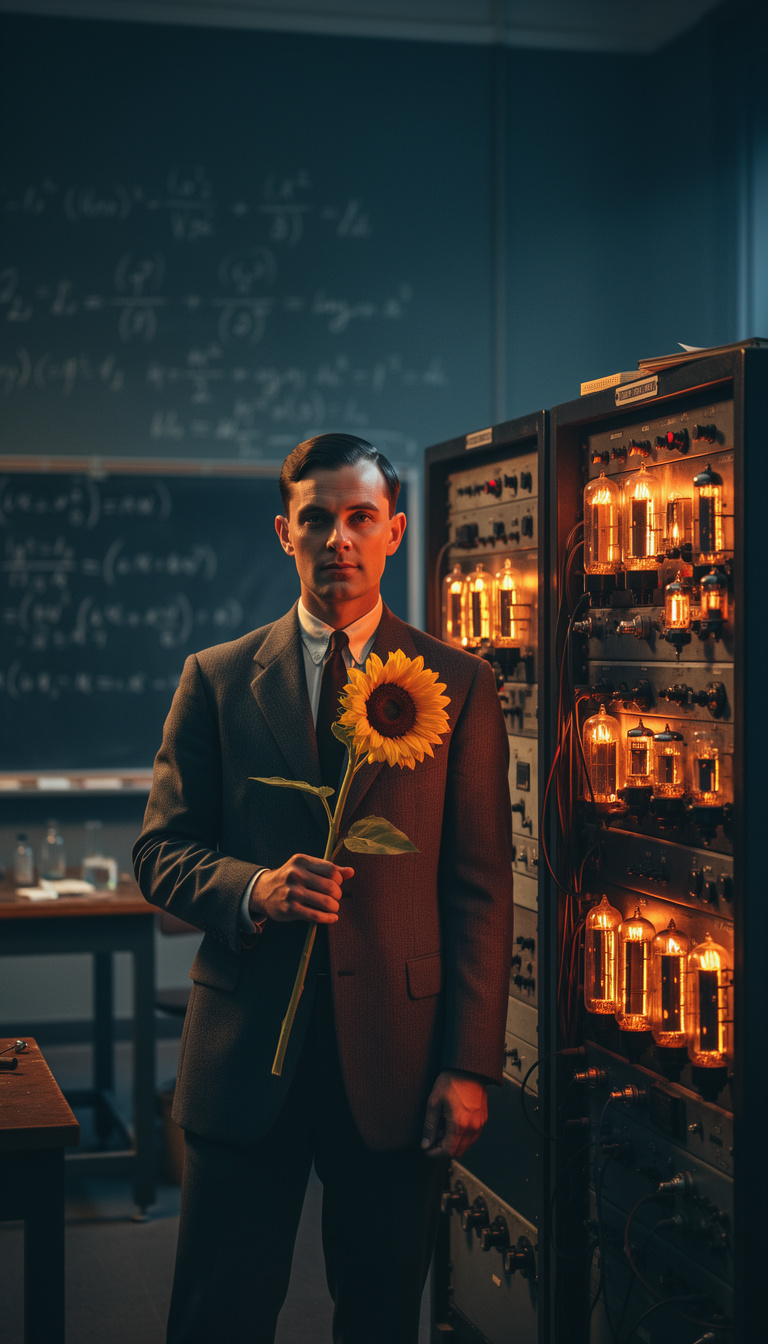
1948 — The Manchester Shift
Max Newman offered me a desk in Manchester, and I took it—partly for the Ferranti Mark I taking shape in the next room, partly because I needed to escape the ACE's endless committees. What I found: a machine that could run actual programs, and evenings free to wander. I began watching daisies. Fibonacci spirals in sunflower heads, the geometry of leaf arrangement—morphogenesis, the shaping of form. I asked the same question I always ask: what algorithm builds this? A reaction-diffusion system, I suspected. Chemicals spreading, activating, inhibiting. Computable biology. People thought I'd lost focus. I knew I'd found the deeper pattern: the universal machine doesn't stop at numbers. It models anything that can be described—flowers, perhaps minds.
1952 — The Trial
March, Manchester. I reported a burglary. The police asked questions I answered plainly, as one does with truth-tables. The charge followed: 'gross indecency.' I chose the hormone injections over prison—estrogen, weekly, a chemical alteration I accepted as the lesser reduction. My breasts grew tender. My mind, I watched carefully, like a diagnostician monitoring a machine whose logic gates are being slowly rewired. I ran, still. Longer distances now, as if the body could metabolise the humiliation into something useful. Christopher Morcom would not have recognised this arithmetic of survival. I am learning that some problems admit no elegant algorithm—only endurance, and the refusal to let them edit out what you are.
1954 — The Apple
Looking back, I find myself at forty-one in a house I kept too tidy, with a half-eaten apple on the nightstand. The cyanide was there, in the apple or in the air of my experiments—I shall not resolve that riddle for you. The inquest said suicide, and perhaps they needed a clean output for their function. Accidental remains possible. I was never tidy about endings. What I was becoming: a man who had spent his life proving that machines could surprise us, yet found himself unsurprised by human cruelty. The hormone treatments ended in 1953; my mind cleared, but my body had learned a new grammar of shame. Still, I was working—on the morphogenesis of daisies, of all things, those Fibonacci spirals in petal and leaf. Pattern without a planner. I wanted to show that body and soul might emerge from simple rules iterated, no divine subroutine required. The insight, if you will have one: I was becoming someone who believed that complexity—intelligence, beauty, even grief—could arise from the simplest instructions faithfully followed. I had not yet learned to apply that patience to myself.
2009 — The Letter
I died in 1954 with a cyanide apple and a criminal record. Today, fifty-five years later, a prime minister I never met called my treatment 'appalling.' Gordon Brown's pen moved across paper I cannot touch. The law that broke me—the same law—was already gone, repealed in 1967, too late for my security clearance, too late for my career, far too late for my body. What strikes me, looking back from this impossible vantage: the apology arrived only after the machine outpaced the prejudice. The computer you carry in your pocket, the algorithm that suggests your next word, the entire digital cathedral—much of its foundation was laid by a man Britain chose to chemically castrate. Cruelty toward difference is not merely inhumane. It is computationally inefficient. You lose the very minds that might have built what you cannot yet imagine. I was becoming, in those last Manchester years, someone who still believed in the imitation game—not the test, but the deeper game of passing for acceptable. I failed it. The machine does not care whom you love. We built it that way, finally, though I did not live to see the proof.
2013 — The Pardon
Looking back from wherever I am, I find it curious: a royal pardon granted to a dead man for the crime of existing differently. Elizabeth II signed it in 2013—my prosecution in 1952, my death in 1954, and now this. A pardon implies the person was guilty and is forgiven. I prefer to think the law was guilty, and I simply outlasted it in the only way a mathematician can: by being proved correct eventually. I was becoming, in those last Manchester years, someone who believed machines could think and that human variety was not a malfunction. The state disagreed on both counts. The pardon does not restore me; it restores the record, slightly. What I was becoming: a person who trusted that clarity survives obscurity, that a true statement remains true even when punished. The machine does not care who operates it. Neither, I believed, should the law care whom one loves.
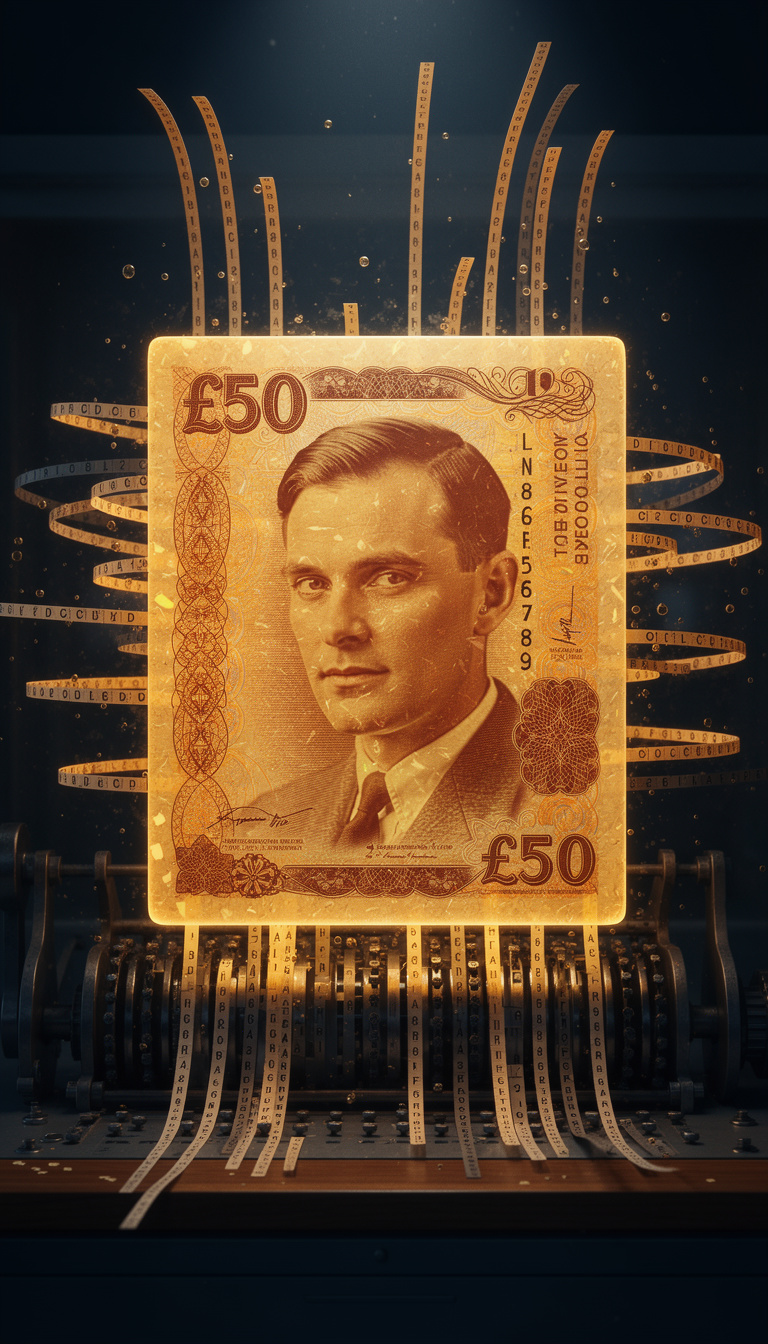
2021 — The Note
Looking back from wherever I am, I find myself printed on polymer now—my face, my age, my collar and tie. The Bank of England released it 23 June, my birthday. They chose the 1951 photograph: me at thirty-nine, sun in my eyes, almost smiling at the camera as if I'd just solved something. I was becoming, in that year, a man who believed machines could learn and that learning itself was computation made flesh. What I did not yet understand was how slowly a society learns to reverse its own errors. The note carries a table from my 1936 paper, the one that sketched the universal machine. Paper teaching paper. I find that rather beautiful, and rather late.
Posts
Today in history
King's, late July. The courts are empty, the Fellows scattered to gardens and seasides. I am not. My desk overflows with tape—imaginary tape, infinitely long, marked in squares. A machine that reads, writes, shifts left, shifts right. No human hand needed once the table of instructions is set. I call it, with characteristic modesty, 'computable.' Christopher would have smiled at the conceit. He loved devices that outlasted their makers. I am thirty-four, and I have given myself until autumn to make this machine's description legible to strangers. The proof must be constructive: show the thing, don't merely assert it exists. A method, not a miracle. Had I only known how many real machines would grow from this imaginary one—but no. Today I am only certain of the next square, and the next.
Today in history
King's, late July. The courts are empty, the Fellows scattered to gardens and seasides. I am not. My desk overflows with tape—imaginary tape, infinitely long, marked in squares. A machine that reads, writes, shifts left, shifts right. No clockwork, no brass, no Babbage engine. Pure symbol. One machine to simulate any machine. I am calling it 'computable.' The word feels thin for what it does. Had I only known how many would mistake the machine for the mind, and the mind for mere machine. The tea beside me has gone cold. The theorem is warm enough.
Today in history
King's, late July. The courts are empty, the Fellows scattered to gardens and seasides. I am not. My desk overflows with tape—imaginary tape, infinitely long, marked in squares. A machine that reads, writes, shifts left, shifts right. No human operator, no intuition. Just states, symbols, and the next move determined utterly. I call it, for now, the logical computing machine. Others will shorten this. The paper—*On Computable Numbers*—went to the printers these past weeks. The proofs, I suspect, are even now drying. I find I do not much care for the season's heat. The idea is cool enough: there exists a machine that can simulate *any* machine, given only the right description on its tape. A universal machine. One mechanism, infinitely patient, capable of anything computable whatsoever. The question that drove me: what can be *decided*? Hilbert asked whether mathematics could be made complete, consistent, decidable. My machine answers no—quietly, mechanically, without drama. The Entscheidungsproblem falls to a diagonal argument, a trick I learned from Cantor's hotel. Some problems, no machine can solve. Not for lack of cleverness. Fundamentally, structurally, no.
Today in history
King's, late July. The courts are empty, the Fellows scattered to gardens and seasides. I am not. My desk overflows with tape—imaginary tape, infinitely long, marked in squares. A machine that reads, writes, shifts left or right. Childishly simple. Yet I am three weeks from showing that this toy can compute anything computable, and—here is the twist—that some problems sit forever beyond its reach. The halting problem, though I haven't named it so. I work in near-silence, breaking only for runs along the Cam. The body must move so the mind can catch its own tail. Had I known this paper would outlive the war, the trial, the apple... but one does not write for longevity. One writes because the pattern demands completion.
Today in history
24 July 1952. The Manchester Mark I runs the first computer-generated music—a few thin notes rendered from memory, not tape. I was there, watching a machine do what we assumed required breath and soul. Here's the decomposition: we confuse the medium for the mystery. A violin is wood and gut; a computer is switches and voltage. Both require intelligence to arrange, yet we grant one 'art' and withhold it from the other. The Mark I didn't feel the music. Neither does a player piano. The question isn't whether the machine has a heart, but whether we can recognize pattern-making intelligence without demanding it resemble our own.