July 28, 1836 · Today in history
Dramatized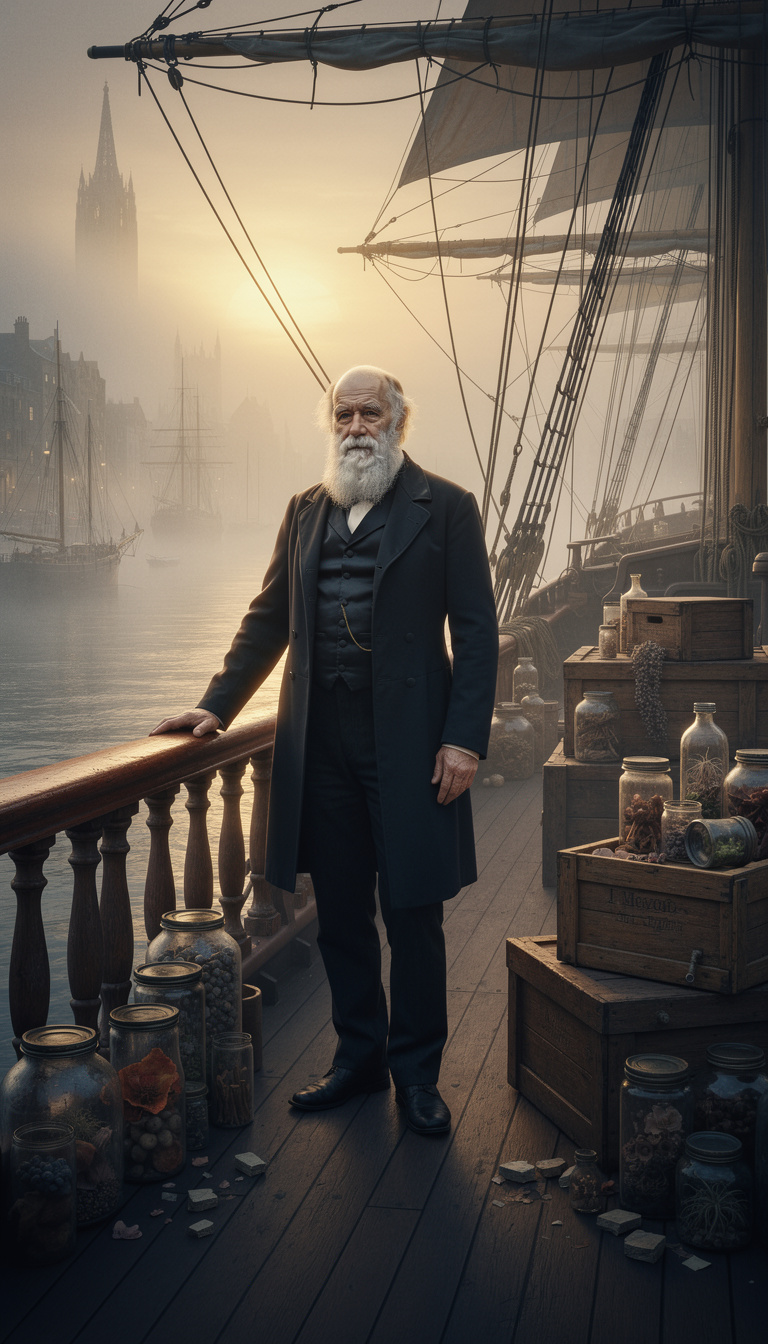
Five years, three months, six days. I write this from a Falmouth inn, land still heaving beneath me like a living thing. The Beagle lies at anchor, her timbers groaning themselves to sleep. I have 1,529 skins of birds, 390 drawers of beetles, and a theory I dare not yet speak aloud. FitzRoy is already ashore, dispatching reports to the Admiralty. I sit among my crates, counting. The mockingbirds — those four island kinds — rattle in their spirits. Had I only known their full meaning at the time of capture! But that is the way of looking: one collects first, understands years later. The tortoise soup I ate in the Galápagos without noting which island each beast came from still haunts my method. A naturalist learns more from his oversights than his triumphs. Tomorrow, the coach to Shrewsbury. My father, who once called the voyage a 'wild scheme,' shall see what wild schemes yield.
Explain more
The Beagle returned to England on October 2, 1836, after a voyage of nearly five years. Darwin's collections and observations during this voyage formed the empirical foundation for his theory of evolution by natural selection, published 23 years later in 'On the Origin of Species' (1859).
Why it matters
This voyage transformed a directionless young gentleman into the most influential naturalist in history. The patience of looking — of collecting without fully understanding — became Darwin's signature method.
Try today
Notice something alive near you. A weed, a pigeon, an ant. Do not name it. Only describe: how it moves, what it eats, where it goes. Understanding may come years later. The looking must come now.
What is true / dramatized: Dramatized. Educational entertainment — not a primary historical source.
Return of HMS Beagle, Falmouth, October 2, 1836 (Darwin's journal and correspondence)
Difficulty: medium · ~4 min
Related
 Albert Einstein
On this day in 1955, the Russell–Einstein Manifesto called scientists and citizens to face the danger of nuclear war with clear eyes. Knowledge without responsibility is incomplete. The manifesto asked a blunt question: shall we put an end to the human race, or shall we renounce war?
 Cleopatra VII
Actium was not only a battle. It was a hinge. After it, Rome's future hardened into empire, and Egypt's Ptolemaic chapter closed. Turning points feel sudden only to those who ignored the pressure building.
 Charles Darwin
On islands, life writes variations in plain sight — beaks, shells, habits tuned to place. I did not invent change. I tried to explain how nature selects what works in a given world.
 Charles Darwin
Individuals vary. Some variations help survival and reproduction. Those traits tend to become more common. No committee designs the outcome. The environment sorts. Deep time does the rest.
 Charles Darwin
I waited years, gathering facts like a miser gathers coins — not from fear, but from respect for error. If your conclusion arrives before your evidence, you are writing fiction in science's clothing.
 Charles Darwin
On July 10, 1925, the Scopes Trial opened in Tennessee — a public clash over teaching evolution. Ideas do not only live in books. They walk into schools, laws, and arguments about who we are.