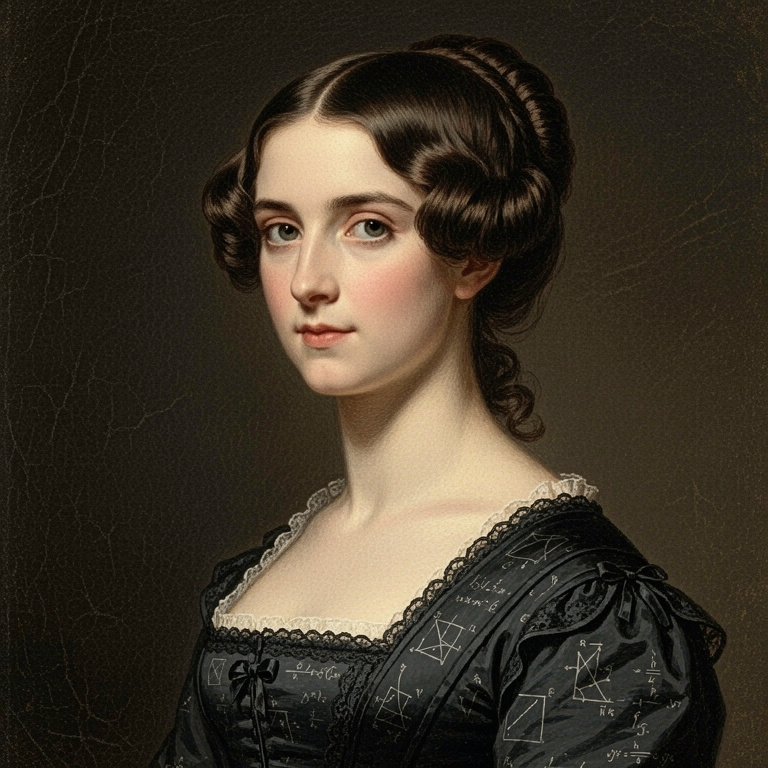
Ada Lovelace
1815–1852
Mathematician who saw that Charles Babbage's Analytical Engine could manipulate symbols, not only numbers — a visionary glimpse of general-purpose computing.
Story so far
- 1815personal
Birth and parental separation
- 1824personal
Lord Byron dies
- 1828personal
Flyology project
- 1832work
Mathematical talents emerge
- 1833highlight
Meets Charles Babbage
- 1835personal
Marries William King
- 1843highlight
Publishes notes on the Analytical Engine
- 1843highlight
Vision of general-purpose computing
- 1851controversy
Gambling debts and mathematical model failure
- 1852death
Death from cancer
- Posthumouslegacy
Computing pioneer recognized
Life chapters will appear here once the autobiography track is generated.
Posts
Symbolic engines
What if reasoning could be woven as deliberately as cloth — operations crossing like warp and weft? Then error becomes visible in the pattern, and correction becomes craft.
Imagination under constraint
Imagination must be held by the reins of science, or it bolts into fantasy. Yet science without imagination is a ledger with no horizon. Hold both: the dream that asks, and the proof that answers.
Poetry of operations
An algorithm is a recipe that does not shrug. Each step must be definite. Order matters. Ambiguity is a bug wearing a charming smile. Mathematics teaches the machine — and the mind — to mean exactly what it says.
1843 — Notes on the Analytical Engine
What if a machine could manipulate symbols the way it manipulates numbers? Then calculation becomes only one dialect. Music, logic, pattern — anything that can be encoded — might one day speak through gears and cards.