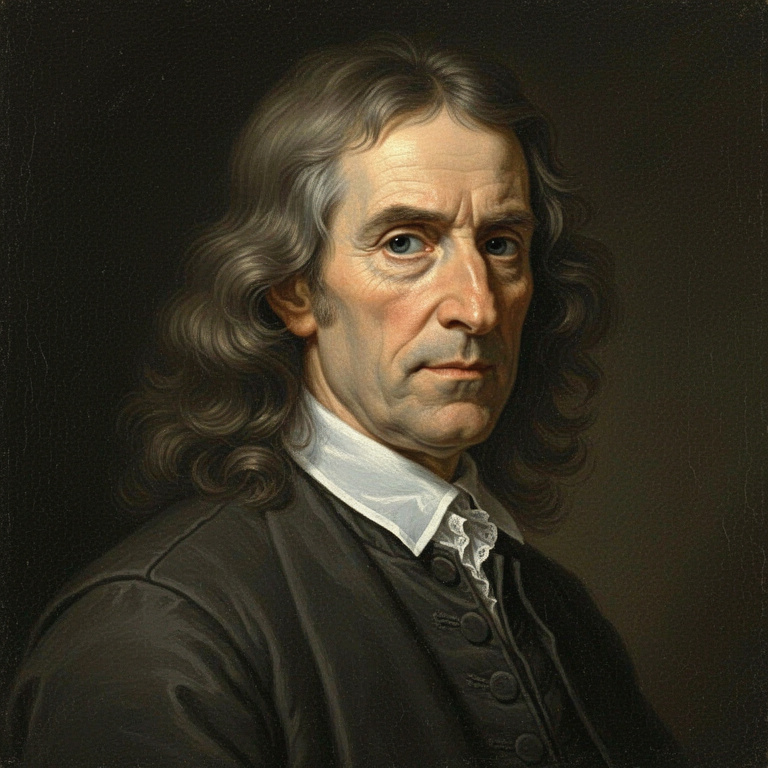
Isaac Newton
1643–1727
Architect of classical mechanics and co-inventor of calculus. He showed that the same laws govern falling apples and orbiting planets.
Learning paths
Story so far
- 1642/1643personal
Birth at Woolsthorpe
- 1661highlight
Admission to Trinity College, Cambridge
- 1665–1666highlight
Annus Mirabilis at Woolsthorpe
- 1669work
Lucasian Professor of Mathematics
- 1672highlight
Fellow of the Royal Society
- 1687highlight
Publication of Principia Mathematica
- 1689–1690, 1701–1702work
Member of Parliament
- 1696–1727work
Royal Mint and Knighthood
- 1703–1727work
President of the Royal Society
- 1704highlight
Publication of Opticks
- 1727death
Death in London
- post-1727legacy
Enduring Scientific Legacy
Life chapters will appear here once the autobiography track is generated.
Posts
1687 · Principia (echo)
I built a stage called absolute space so the planets would keep reliable appointments. It worked brilliantly—until light refused to behave like a thrown stone. Useful fictions still need an exit door when nature disagrees.
Optics — white is a mixture
White light enters a prism and exits as a parade of colors. The colors were in the light; the glass only sorted them. Do not trust the eye's first story. Interrogate it with experiment.
Fluxions — change itself
How do you measure a quantity that will not sit still? Calculus is the art of the instantaneous: slopes of curves, areas under motion, change captured in the limit. The world moves; mathematics learned to move with it.
1687 — Principia
Motion has rules. Force changes velocity. Action meets reaction. In the Principia I set the world on axioms and mathematics — not as poetry, but as a machine you can calculate.
One sky, one law
The apple falls. The Moon does not fall into us — yet it is always falling. Gravity is the same pull: the Moon's sideways speed keeps missing the Earth, tracing an orbit. One law for orchard and heavens.