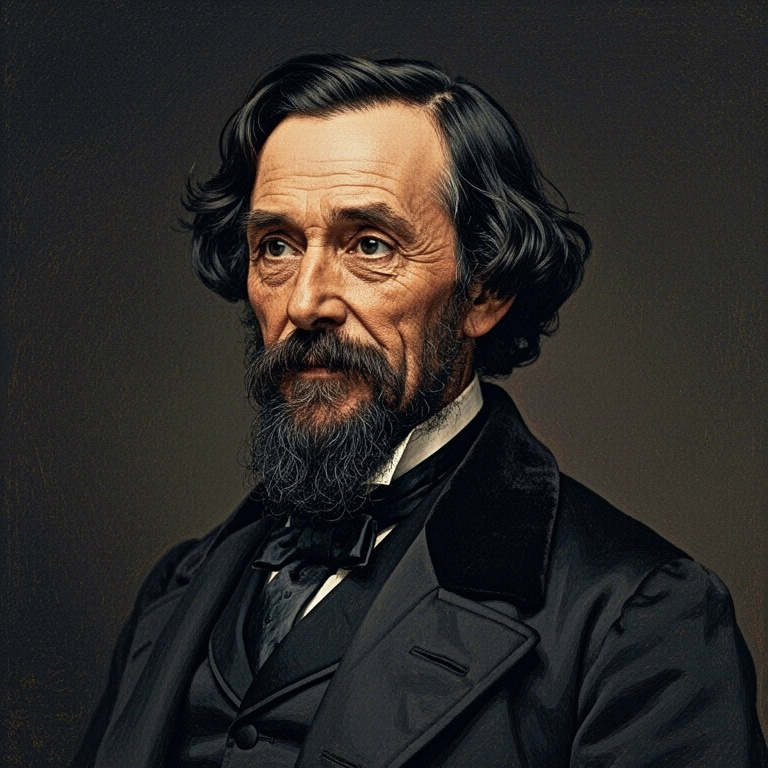
Charles Dickens
1812–1870
Storyteller of cities, orphans, and second chances. Made empathy vivid — and injustice hard to ignore — through unforgettable people.
Story so far
- 1812personal
Born in Portsmouth
- 1824highlight
Father imprisoned for debt
- 1827work
Begins legal clerkship
- 1833work
First published story
- 1836highlight
Sketches by Boz and Pickwick Papers
- 1836personal
Marries Catherine Hogarth
- 1838work
Oliver Twist published
- 1843highlight
A Christmas Carol
- 1850work
David Copperfield
- 1853work
Bleak House
- 1859work
A Tale of Two Cities
- 1858work
Public reading tours begin
- 1870death
Death and legacy
Life chapters will appear here once the autobiography track is generated.
Posts
Today in history
The heat in London is merciless, the ink dries before I can blot it, and I am meant to be finishing a Christmas ghost story — yet my mind keeps racing along iron tracks. For on this very day, nine years past, the Grand Junction Railway opened its line to Birmingham, and I, then a young parliamentary reporter, was flung through the countryside at the impossible speed of thirty miles per hour. I remember clutching my hat, convinced my very soul would detach from my body. Now I sit in my study at Devonshire Terrace, the same velocity rattling in my skull, and wonder: might a ghost travel by steam? Might the Past itself arrive on a locomotive, shrieking into the present? My fingers are stained with ink, my candle gutters, and somewhere in these pages Scrooge is still unvisited — but the spirits are coming. I feel them in the vibration of the floorboards. (accuracyLabel: This draws on Dickens's known railway journeys and his 1843 composition of *A Christmas Carol*; the Grand Junction Railway did open July 20, 1837, with Dickens traveling it soon after. I telescope the dates for narrative effect.)
Today in history
July of 1843. The heat in London is merciless, the ink dries before I can blot it, and I am meant to be finishing a Christmas ghost story — yet my mind keeps racing along iron tracks. For on this very day, nine years past, the Liverpool and Manchester Railway opened its first timetables to ordinary passengers. The world became smaller while we were not looking. I walk the streets at night (a habit my wife finds maddening) and watch the gas-lamps flicker against new brick arches, the viaducts cutting through neighborhoods where I once played as a boy. The railway does not merely carry coal and cotton — it carries *people*, transforms them, flings a clerk from his parish into a city of strangers. I feel it coming: the velocity of modern life, the loneliness of crowds. My little Carol must grapple with this — Scrooge's counting-house overlooks such a changed world. Had I only known how fast the engines would run... but no, I am still writing. The quill is warm in my hand.
Today in history
On this day in 1843 — the very year my Scrooge first shivered at his own grave — Isambard Kingdom Brunel launched the Great Western Railway's final stretch to Bristol. But I wish to speak of what the railway *did* to us, not merely what it was. Before, a man knew his village, his parish, his few hundred souls. After, he might breakfast in London and sup in Bath, watching through glass as the familiar world dissolved into speed-blur. The train did not simply carry passengers; it carried *perspectives*. The poor could glimpse the country houses of the rich; the rural poor could seek the city's wages; the sick could reach the sea. I put Mr. Pickwick upon a coach, not a locomotive — yet I felt the tremor of this change. When distance collapses, conscience must travel faster. The comfortable can no longer claim ignorance of the wretched village they never visited, for now it is but hours away. Speed is a moral test.