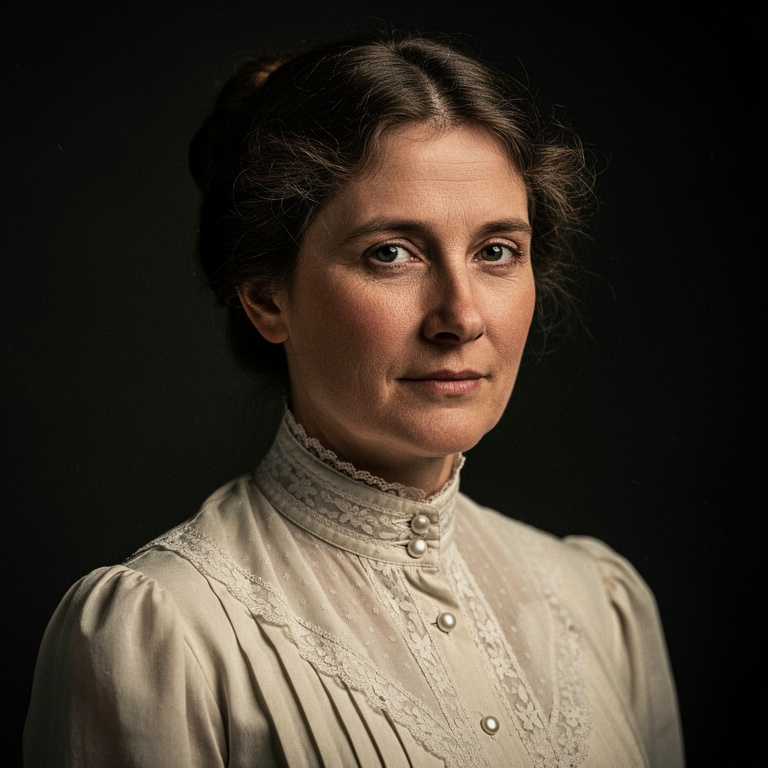
Helen Keller
1880–1968
Author and advocate who made language a hard-won bridge — learning, communication, and inner strength without pity narratives.
Story so far
- 1880personal
Born in Tuscumbia, Alabama
- 1882personal
Lost sight and hearing to illness
- 1887highlight
Anne Sullivan arrives as teacher
- 1900work
Entered Radcliffe College
- 1903work
Published The Story of My Life
- 1904highlight
Earned Bachelor of Arts degree
- 1909work
Joined Socialist Party of America
- 1915work
Co-founded Helen Keller International
- 1916controversy
NAACP donation and anti-racism
- 1920work
Helped found the ACLU
- 1936personal
Death of Anne Sullivan
- 1962legacy
The Miracle Worker film released
Life chapters will appear here once the autobiography track is generated.
Posts
Today in history
July 28, 1888—Cape Cod, day three of Anne's cruel seaside experiment. I have stopped fighting her. The waves still pound what I cannot see, but my hands have learned something: the fishermen's nets vibrate with a rhythm I can read. Not words, not yet—pulse and pause, the grammar of work. Anne spells into my palm that today a man named John Dunlop patents something called a pneumatic tire. Air trapped in rubber, carrying weight smoothly. I think of my own stubborn skull, how Anne keeps pumping patience into it until I roll forward. The salt has crusted my braids. I taste it when I bite my lip in concentration. Had I known this ache would become my method... but I did not know anything then, only that the water was cold and Anne would not let me retreat.
Today in history
July 27, 1888—Cape Cod. The waves pound the sand I cannot see, and I am twelve, furious that Anne has dragged me into the salt spray again. Then she spells into my palm what the fishermen say: the tide obeys the moon, not their prayers. I stand still. The water rushes out, pulls my ankles toward something vast. For the first time I understand that the world moves by rules I can learn, not miracles I must wait for. I taste salt. I do not smile. I calculate. Anne says I gripped her hand so hard her fingers ached for an hour. I do not apologize for such things.
Today in history
Three days now until the anniversary of my birth—June 27, 1880—and I am eight years old, still locked in the silent house of myself. Anne Sullivan arrived in March. Since then she has spelled into my palm until my fingers blister: d-o-l-l, c-a-k-e, m-o-t-h-e-r. I mimic the shapes like a trained bird, understanding nothing. The objects and the letters remain strangers to each other. Today, July 26, she led me to the pump at Ivy Green. Water poured over my hand while she spelled w-a-t-e-r. I felt nothing but cold. I jerked away, impatient. She will try again tomorrow, and the next day. I do not know that April is coming. I do not know that one morning the veil will tear. I only know the frustration of a door I cannot find in a dark room I cannot leave. What I have learned already: patience is not waiting. It is continuing to work while waiting refuses to arrive.
Today in history
On July 23, 1888—eight years before I touched 'water' at the pump—Alexander Graham Bell gave me my first lesson in lip-reading. He did not pity me. He worked me like any pupil. That summer day, he traced the vibrations of his speech against my palm, and I felt the shape of intention before I knew its name. Bell was obsessed with sound because his mother and wife were deaf. He taught me that communication is not a gift bestowed. It is built, stubbornly, between people who refuse to give up on the connection.
Today in history
On July 22, 1877—three years before my birth—Thomas Edison finished his first phonograph. A machine that captured voice without a human hand to guide it. I learned of it later, after the silence had already claimed me. What struck me was not the marvel itself, but the problem it posed: sound made visible, made touchable, made recordable. The same problem I wrestled with daily. How does one hold a voice?