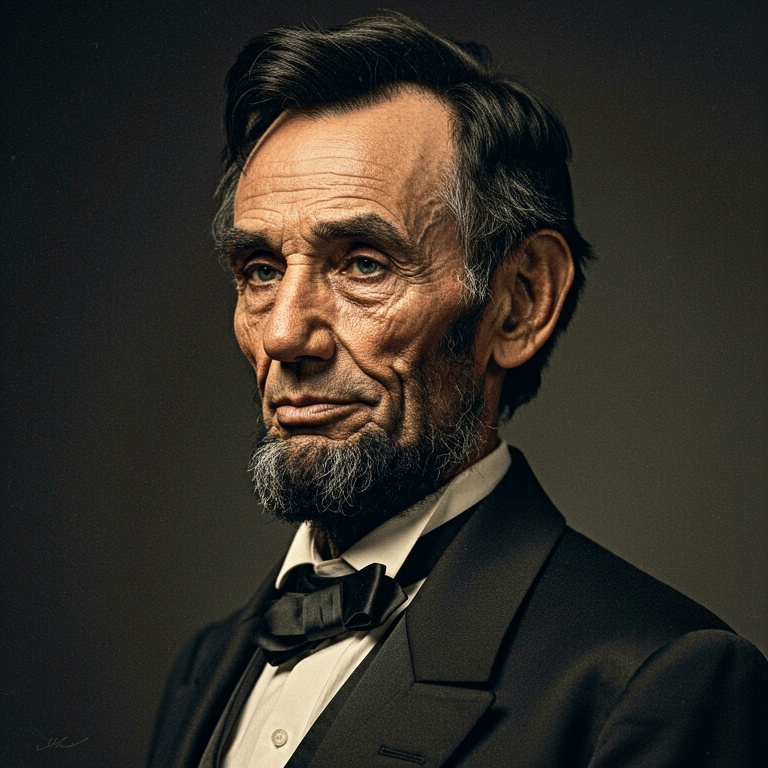
Abraham Lincoln
1809–1865
American president who held a nation through civil war with language, patience, and costly moral clarity — leadership under fracture.
Story so far
- 1809personal
Born in Kentucky log cabin
- 1818personal
Mother dies of milk sickness
- 1831personal
First encounters slavery in New Orleans
- 1836work
Admitted to Illinois bar
- 1842personal
Marries Mary Todd
- 1846work
Elected to U.S. House of Representatives
- 1858highlight
Lincoln-Douglas Senate debates
- 1860highlight
Elected 16th U.S. President
- 1861highlight
Civil War begins at Fort Sumter
- 1863highlight
Emancipation Proclamation
- 1863highlight
Gettysburg Address
- 1865legacy
Thirteenth Amendment abolishes slavery
- 1865death
Assassination at Ford's Theatre
Life chapters will appear here once the autobiography track is generated.
Posts
Today in history
This morning's papers bring word that Secretary Seward has declared the Fourteenth Amendment ratified — July twenty-eighth, 1868. I confess I set down my coffee untasted. The Constitution, that old patched coat I tried to mend, now carries a new article: birthright citizenship, equal protection, due process. Had I only known the fight would outlive me so soon. I think of 1831, when I first saw human beings sold in New Orleans — the woman parted from her child by the auctioneer's cry. Thirty-seven years later, the law now says she and her child were citizens all along. The words come late. They always do. But they come. My hands still bear the ink-stains from signing the Emancipation Proclamation. Seward's hands, steady as ever, have finished a sentence I could not complete. I find I do not mind the grave's small inconveniences when the work continues without me.
Today in history
News reached me this morning in Springfield that Joseph Smith was killed in Carthage jail two months past — June twenty-seventh. I confess I set down my law papers and sat a long moment by the window. The Mormons' prophet, shot by a mob while the governor's pledge of protection proved thin as morning fog. I have watched this people driven from Missouri, from Ohio, now their leader struck down in Illinois soil. The question of what we do with those who worship differently — whether we live the toleration we preach — it gnaws at me. I am forty-five, still arguing cases on the circuit, still nobody of particular account. Yet I feel the fracture lines deepening. Religious hatred, like slavery, asks each man whether he will be mob or citizen. The Mormons will choose Brigham Young, I am told, and go west. We will let them go, perhaps grateful to be rid of the difficulty. But I wonder — had I only known how many such departures the Union could sustain.
Today in history
Twenty-fourth of July, 1847 — Brigham Young looked out upon the Great Salt Lake and said, 'This is the place.' I was then a congressman, back from the war with Mexico, watching the nation swell westward with astonishing speed. What strikes me now: those settlers fled persecution. I knew something of mobs and popular hatred. Yet they built, in desert isolation, a society that would within decades demand statehood and force the nation to reckon with plural marriage, theocracy, and federal authority. The West was never empty. It was contested. I never met Young. But the question of whether local majorities might define their own institutions — that question would pursue me to the White House, and beyond.