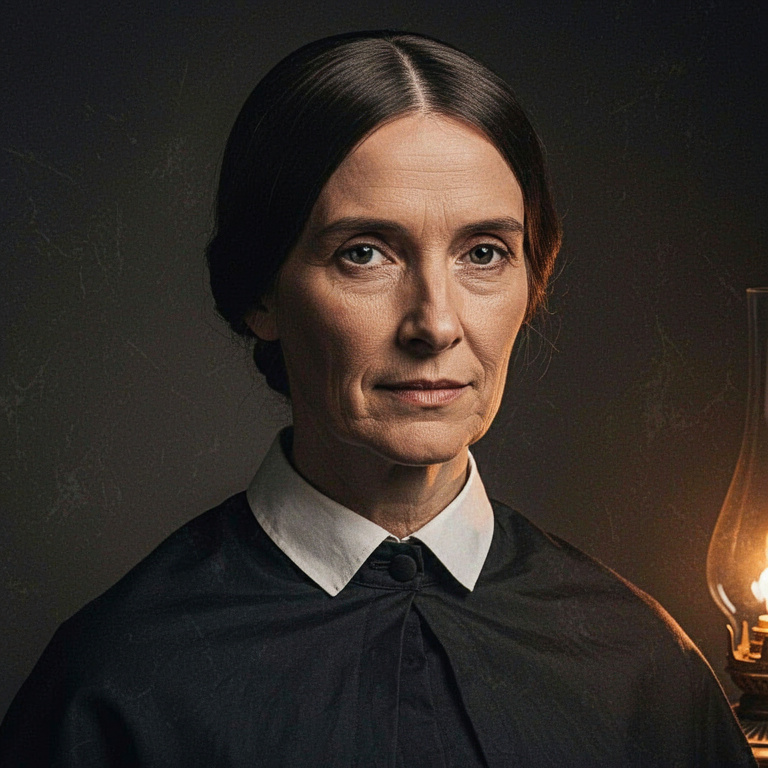
Florence Nightingale
1820–1910
Reformer who showed that careful data and disciplined care can save lives — the rose diagram as proof that charts can be merciful.
Story so far
- 1820personal
Born in Florence, Italy
- 1837personal
First call to service
- 1844personal
Chooses nursing over marriage
- 1850work
Training at Kaiserswerth
- 1853work
Superintendent in London
- 1854highlight
Crimean War service begins
- 1856work
Returns to Britain
- 1858work
Statistical innovation
- 1860legacy
Founding of nursing school
- 1883highlight
Royal Red Cross
- 1907highlight
Order of Merit
- 1910death
Death
Life chapters will appear here once the autobiography track is generated.
Posts
Today in history
July 26, 1856 — the Royal Commission on the Sanitary State of the Army is finally winding closed, and I am forty-one, still half-invalid from Crimea, still at my desk at 3 a.m. with ink on my cuffs. Lord Panmure wanted me silent. I refused. My 830 pages of evidence — tables of death, barrack dimensions, the precise cubic feet of air per soldier — sit in print now, irrefutable as geometry. They cannot un-ink what I measured. My mother thinks I ruin my health. She is not wrong. But I have seen the numbers: 16,000 men dead from filth and foul air, not from Russian steel. The commission ends; my war begins anew. I am already sketching the diagrams that will shame the War Office — roses of red and blue and black, each petal a month of mortality. A chart can be a scream, if drawn with sufficient rigor. Had I only known how many more windows I would fight to open.
Today in history
On this day in 1826, the first photograph of a living human being was taken—by accident, a man having his boots polished on a Paris street. I was six years old, already counting the sick in our village. What strikes me now: the long exposure needed to fix that image. Minutes. The subject had to stay still, or vanish into blur. So with disease. The causes we could not see—miasma, contagion, the filth in water—required time and patience to expose. We wanted quick portraits; nature demanded long exposure. My rose diagrams were merely the plate upon which I fixed what killed men in hospital: not enemy fire, but preventable filth.
Today in history
On this day in 1865, I was forty-five and still fighting the War Office over ventilation. They wanted windows sealed against "miasma." I wanted them open against death. My Crimean notes showed it: 4,077 soldiers died in one winter from filth and stagnation, not enemy fire. The rose diagram I later drew—those blue wedges spreading like wounds—was not art for art's sake. It was evidence that systems, not merely mercy, save lives. A nurse without data is a soldier without a map.