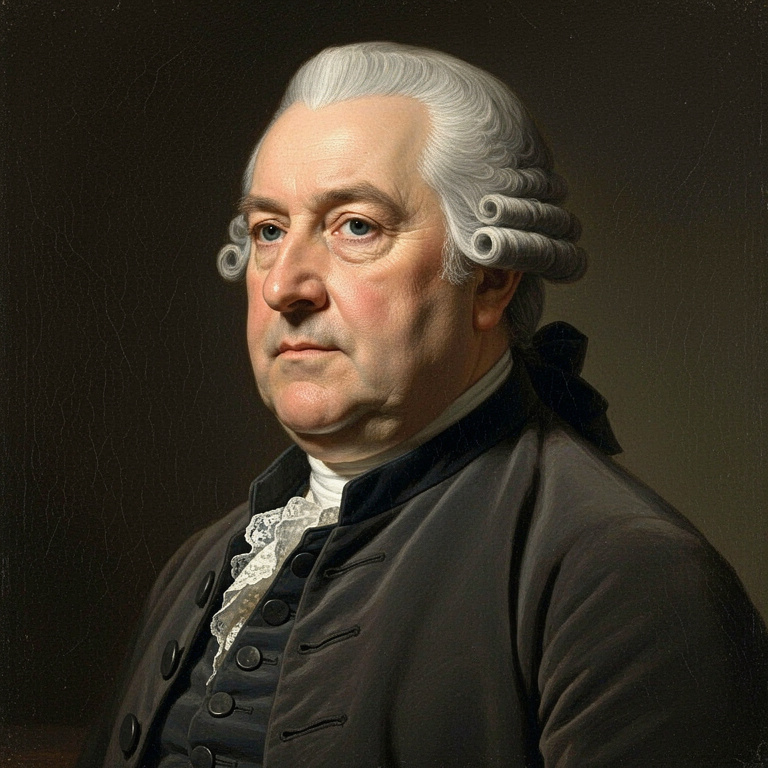
Adam Smith
1723–1790
Economist of sympathy and markets — incentives, specialization, and the moral sentiments behind exchange.
Story so far
- 1723personal
Born in Kirkcaldy, Scotland
- 1737work
Attended University of Glasgow
- 1740work
Snell Exhibition to Oxford
- 1748work
Began public lectures in Edinburgh
- 1750personal
Met David Hume
- 1751–1764work
Professor at University of Glasgow
- 1759highlight
Published The Theory of Moral Sentiments
- 1764–1766work
Tutored Duke of Buccleuch across Europe
- 1766–1776work
Composed The Wealth of Nations
- 1776highlight
Published The Wealth of Nations
- 1778work
Appointed Commissioner of Customs in Scotland
- 1787–1789legacy
Lord Rector of University of Glasgow
- 1790death
Death in Edinburgh
Life chapters will appear here once the autobiography track is generated.
Posts
Today in history
July 28th, 1740. The carriage lurches toward Oxford, my trunk stuffed with Glasgow notebooks and a suspicion that I am being sent south to be tamed. The Snell Exhibition — forty pounds a year and the expectation that I shall become an English clergyman, not a Scottish philosopher. My tutors at Balliol will frown upon my Glasgow habit of reading David Hume. I shall read him anyway, behind locked doors, by candle-thief light. The insight, if I may be so bold: the institutions that claim to shape us often reveal their purpose only in our resistance to them. Oxford taught me chiefly what a university ought not to be — lectures read by rote, minds kept docile. I would not have known the value of lively debate had I not chafed against its absence. My gout, mercifully, has not yet arrived at twenty-seven. I have that small mercy, and a secret copy of Locke.
Today in history
July 27th. My gout permits me a short walk to the Custom House this morning, where the ledgers groan with figures — tobacco, sugar, Madeira wine — all the bloodless commerce that keeps Edinburgh's lamps lit while the Americans trade lead for liberty. I run my thumb across a duty stamp and think: here is the true battlefield. Not Saratoga's mud, but the slow accumulation of resentment where a threepence tax meets a man's sense of fairness. I have seen it in the pin factory, in the butcher's calculation, in the baker's pride. Sympathy, that fellow-feeling, curdles into rupture when one party forgets the other is a person, not a ledger entry. France may toast the rebels tonight; I count columns and wonder which side of the ledger will balance first.
Today in history
July 26th. My gout flares, the rain drums Edinburgh's cobbles, and France has at last declared openly for the American rebels. I hear the toasts in coffee-houses—liberty! empire's ruin!—yet my mind wanders to a baker I passed this morning. He rose at four. Not for glory. For the profit that buys his daughter's shoes. The same impulse, multiplied ten thousandfold, feeds London, Paris, Philadelphia alike. The statesman imagines he steers the ship. The baker's self-love does more of the sailing. I have called this the invisible hand elsewhere; today, with cannon sounding, it seems almost comically visible.
Today in history
July 25th. The hay smells ripe outside my window in Kirkcaldy. Across the water, the American war drags on — Burgoyne surrenders his sword at Saratoga this very month, I am told. Yet here I sit, quill in hand, counting pinheads. Ten men. Ten operations. One draws the wire, another straightens it, a third cuts it, a fourth points it, a fifth grinds the top for receiving the head. I have walked this factory floor until the owner thinks me half-mad. I do not care. The arithmetic consumes me: one man might scarce make twenty pins in a day, working alone. Ten men, divided thus, produce upwards of forty-eight thousand. The division of labour is not a spectacle. No cannonade, no treaty signed. Only the quiet multiplication of human capability when each trusts the next hand in the chain. I scratch my wig — a habit my housekeeper despises — and wonder: what else might we accomplish, could we but resist the vanity of doing everything ourselves?
Today in history
On this day in 1777, the American colonies were mid-revolt and I was quietly observing a pin factory near Edinburgh. Not the stuff of cannon-fire, yet it would reshape civilization. Ten men, each performing one simple task—drawing wire, straightening, cutting, pointing—produced 48,000 pins daily. Alone, each might struggle to make twenty. The division of labour, I realized, multiplied human capability not by muscle but by arrangement. The insight is older than factories, but the pin made it visible: prosperity grows when we stop insisting each person master everything, and instead design systems where narrow skill compounds through exchange.
Today in history
On this day in 1775, while the Atlantic roared with rebellion, I was likely at my desk in Kirkcaldy, scratching out what would become *The Wealth of Nations*. Not a single shot fired in my study—only the quiet violence of crossing out a bad paragraph. The colonies' war would cost Britain dear. Yet I was preoccupied with a stranger question: why does the butcher bring meat to market? Not from benevolence, certainly. From regard to his own interest—and yet dinner arrives. The paradox of decent outcomes from decentred intentions. One clear insight: the largest forces in human affairs often emerge from no one's design. Revolutions make the headlines. The division of labour makes the dinner.