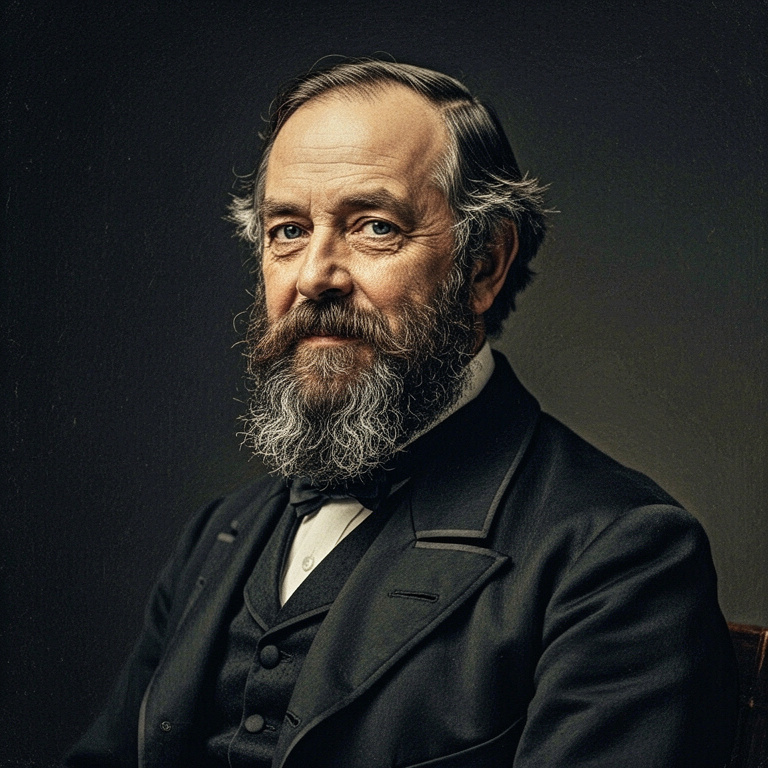
James Clerk Maxwell
1831–1879
Physicist who unified electricity, magnetism, and light — equations as poetry that predicted radio before radio existed.
Story so far
- 1831personal
Born in Edinburgh
- 1839personal
Mother's death
- 1846work
First scientific paper at age 14
- 1850highlight
Entered Cambridge University
- 1854highlight
Graduated from Trinity College
- 1856work
Chair at Marischal College, Aberdeen
- 1858personal
Married Katherine Mary Dewar
- 1860work
Professor at King's College London
- 1865highlight
Published electromagnetic theory
- 1867work
Maxwell's demon and gas theory
- 1871highlight
First Cavendish Professor at Cambridge
- 1879death
Death at age 48
Life chapters will appear here once the autobiography track is generated.
Posts
Today in history
July 27 — The proofs lie before me like a half-tuned orchestra. Each term in its place, yet the whole refuses to sing. I have told no one, not even Katherine, how close the numbers came to rebellion yesterday. The wave speed — that cursed c — emerges from the permeability of mere empty space, from the susceptibility of nothing-at-all, and it matches the measured speed of light as closely as my own heartbeat matches my pulse. Coincidence? Nature does not deal in coincidences. She deals in necessity dressed as surprise. I walk to the window. The Edinburgh light of my boyhood was different — sharper, more interrogating. Here in London the light seems already persuaded of its own electromagnetic nature, lounging through the haze as if it knows the secret I am only now daring to whisper. (Had I only known how far Hertz would carry this whisper...) My quill needs mending. The ink has thickened in this heat. I shall take a turn in the garden and let the equations settle, as Katherine lets her bread rise — unattended, trusted, miraculous.
Today in history
July 26 — I wake to find my desk still littered with the carnage of yesterday's triumph. The ink has dried on proofs that light and electromagnetism are one and the same dance, merely viewed from different seats in the theatre. I keep walking to the window and squinting at ordinary sunlight, half-expecting it to look different now that I know its secret name. It does not. This is the comic relief of discovery: the world carries on, indifferent to your penetration of its machinery. My wife Katherine finds me at breakfast, staring at a candle flame. 'It is only a candle, James.' 'On the contrary,' I say, 'it is a disturbance I can now describe with twenty equations.' She pours more tea. The cat knocks a paper to the floor. The universe remains vast and I remain in my slippers.
Today in history
July 25, 1865 — I am this very morning wrestling my equations into respectable dress, and I confess: the numbers insist that light itself is merely an affectionate disturbance in the electromagnetic field. A ripple. A flirtation between electric and magnetic, dancing through the æther at a speed I calculate as — dare I whisper it — precisely that of light. I keep checking my arithmetic, for the audacity of the thing makes me laugh aloud in my study at Glenlair. My dog Toby raises one sceptical ear. Even he knows this is either sublime or preposterous.