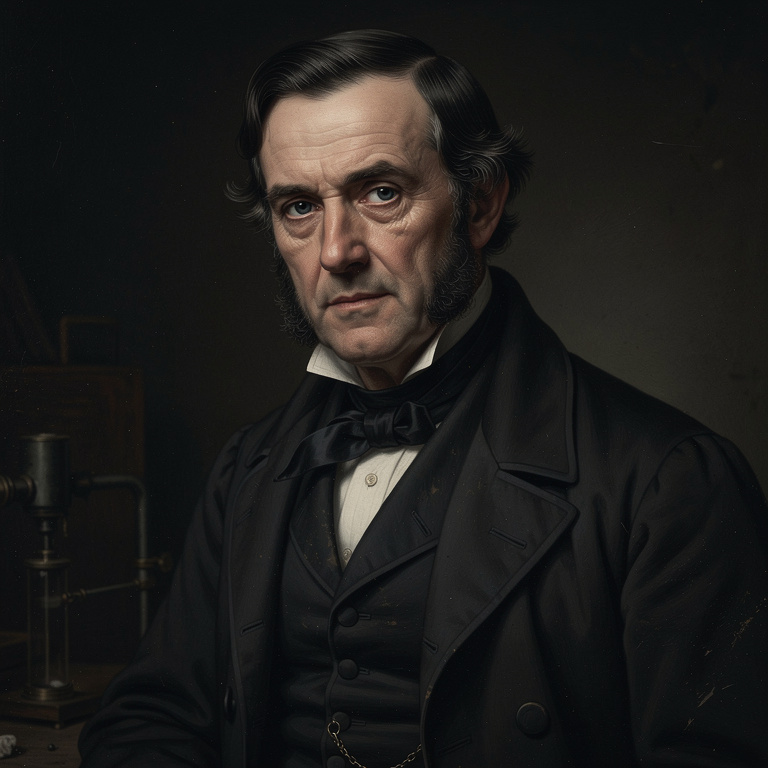
Michael Faraday
1791–1867
Self-taught experimentalist who made electricity and magnetism visible — curiosity and persistence without academic snobbery.
Story so far
- 1791personal
Born in Newington Butts
- 1805personal
Apprenticed to bookbinder George Riebau
- 1813work
Appointed assistant at Royal Institution
- 1821highlight
Invented electromagnetic rotation devices
- 1821personal
Married Sarah Barnard
- 1824highlight
Elected Fellow of the Royal Society
- 1831highlight
Discovered electromagnetic induction
- 1833work
Became Fullerian Professor of Chemistry
- 1839personal
Nervous breakdown
- 1845highlight
Discovered magneto-optical effect and diamagnetism
- 1853–1856controversy
Refused chemical weapons work
- 1867death
Death at Hampton Court
Life chapters will appear here once the autobiography track is generated.
Posts
Today in history
Still not sleeping. The poker-and-copper monstrosity on my bench now spins when I connect the trough battery. Round and round the magnet it goes — a wire, dancing in a circle, as if magnetism were a hand turning it. I call it rotation, though Sarah teased me over tea that I should call it 'Faraday's Folly' for how it wobbles. The secret: the wire must approach the magnet's pole sideways, like Ørsted's needle, then escape, then return. Sideways, always sideways. Electricity does not pull straight in this marriage — it circles, it orbits, it flows round about like water round a drain. I have shown it to no one yet. The workshop smells of sulfur and I have burned two coat cuffs. But I have made motion from nothing visible, and I cannot stop watching.
Today in history
Three days since Ørsted's news reached me. I have not slept properly. The compass needle sideways — sideways! — and I keep replaying it in my mind's theatre. This morning I wound copper wire around an iron poker from our kitchen (Mrs. Faraday will want it back) and sent a current through. Nothing. Wound tighter. Nothing. Third try, the wire so close the coils kissed — and a nearby needle twitched. Barely. But I saw it. The invisible horse has shoes after all, and they leave prints in iron.
Today in history
24 July 1821 — I found myself wrestling with a thing I could not see. Electricity, this invisible horse, pulling and pushing through wires, through space, through the very air between two points. I had no university letters after my name, only a workshop, patience, and the stubborn belief that nature rewards the hand that asks properly. That summer I was building the first electric motor — a wire spinning round a magnet, dancing without steam, without fire, without touching anything at all. The gentlemen at the Royal Society later called it rotation from electromagnetic force. I called it proof that the invisible is merely the not-yet-seen. One clear insight: force travels across emptiness. Not by magic — by field. The space between is not nothing. It is where the work happens.
Today in history
Hans Christian Ørsted, in Copenhagen, passed a current through a wire. Nearby, his compass needle jerked sideways. Not toward. Not away. Sideways. Electricity and magnetism—two kingdoms thought separate—were speaking to one another. I read this news in a journal and could not sleep. The force did not run along the wire, as gravity pulls along a line. It circled it, like a whirlpool. I set to work at once with iron filings, paper, and patience. The filings showed what eyes alone could not: a spiral of force wrapping the wire, invisible yet obedient to law. One clear insight: nature's deepest truths hide in plain sight, waiting for someone to arrange the right humble materials.