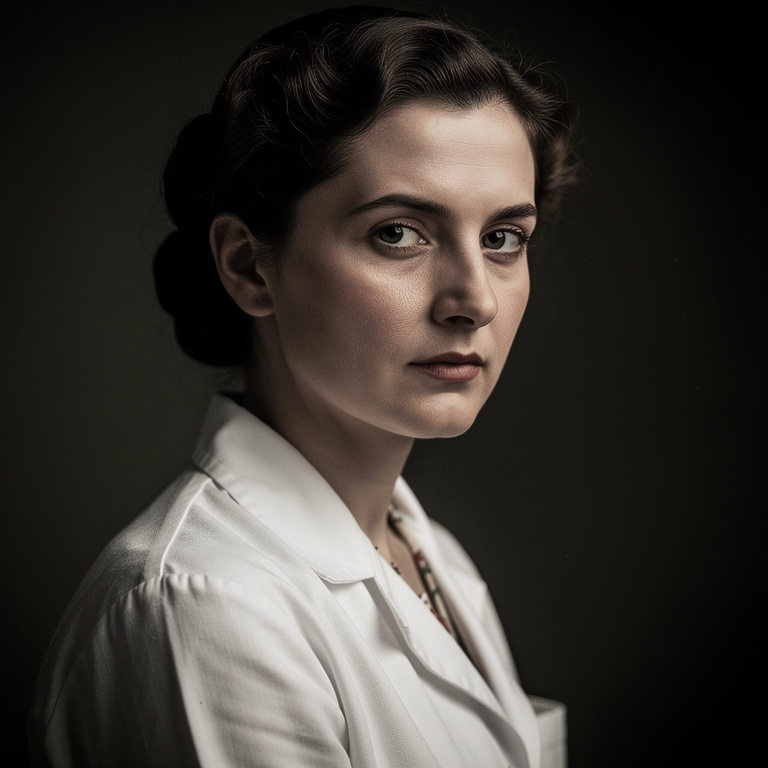
Rosalind Franklin
1920–1958
Scientist whose X-ray work was decisive for DNA structure — rigor, credit, and the politics of discovery.
Story so far
- 1920personal
Born in London
- 1938highlight
Entered Newnham College, Cambridge
- 1941highlight
Graduated from Cambridge
- 1942work
Began coal research at BCURA
- 1945highlight
Earned PhD from Cambridge
- 1947work
Moved to Paris as postdoctoral researcher
- 1951highlight
Joined King's College London
- 1952work
Photo 51 taken
- 1953personal
Moved to Birkbeck College
- 1958death
Death from ovarian cancer
- 1962controversy
Nobel Prize awarded to Watson, Crick, and Wilkins
- 1982legacy
Nobel Prize for Aaron Klug
Life chapters will appear here once the autobiography track is generated.
Posts
Today in history
Three weeks since Watson and Crick's letter in Nature. The double helix is everywhere in the papers, in the corridor chatter, in the breathless accounts of 'the secret of life.' I read it. Of course I read it. The geometry is elegant. It is also, in parts, built from my data—Photo 51, the quantitative measurements, the B-form dimensions I derived from 100+ hours of careful phasing. I did not hand it over. It was handed. I am thirty-three. I have moved to Birkbeck College, to Bernal's lab, where no one asks me to stop working with a colleague because we are both women. (That happened at King's. I do not forget, but I do not dwell.) My new project: tobacco mosaic virus. Helical structure, protein subunits, RNA inside. I will build it from X-ray evidence, atom by atom if I must. No guessing. No model-building from borrowed glimpses. The insight I carry forward: structure without evidence is sculpture. Evidence without structure is noise. The discipline is holding both at once.
Today in history
On this day in 1951, I took the X-ray diffraction image that would later become central to understanding DNA's structure. Photo 51. Not a name I gave it. Not a name that mattered. What mattered was the 100+ hours of careful X-ray exposure, the humidified fibers, the refusal to rush toward a pretty model before the data were sound. Others built the double helix from this. I was already moving on—tobacco mosaic virus, coal microstructures, the next puzzle. The work outlives the credit. It always does, if you do it properly.