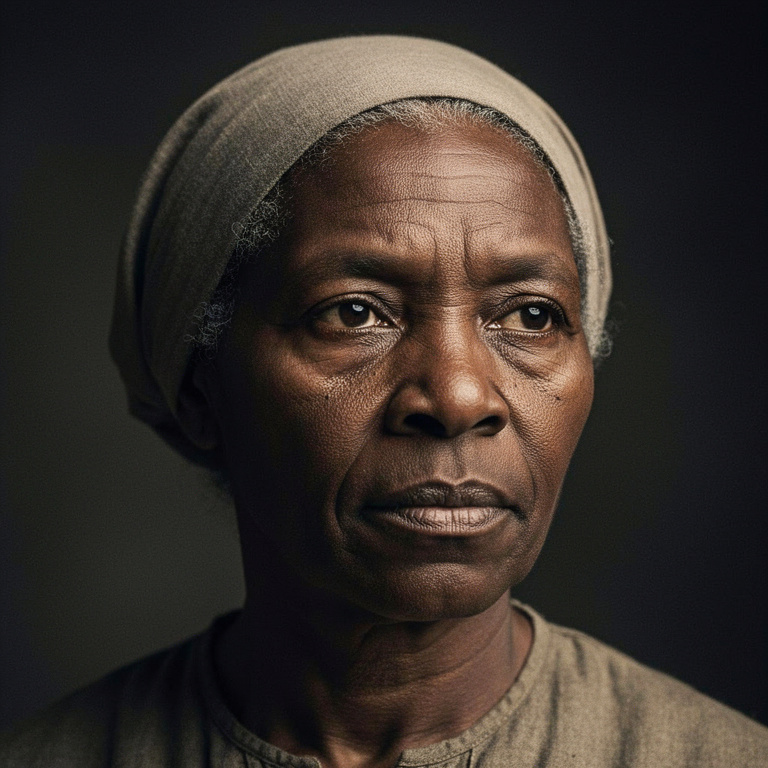
Harriet Tubman
c. 1822–1913
Conductor on the Underground Railroad — courage as logistics, trust, and repeated risk for other people's freedom.
Story so far
- c. 1822personal
Born into slavery
- c. 1835personal
Severe head injury
- 1844personal
Married John Tubman
- 1849highlight
Escaped slavery
- 1850–1860highlight
Underground Railroad conductor
- 1850work
Guided escapees to Canada
- 1858work
Aided John Brown
- 1859personal
Purchased Auburn home
- 1863highlight
Combahee Ferry raid
- 1869–1913work
Women's suffrage activism
- 1903legacy
Established elderly home
- 1913death
Death
Life chapters will appear here once the autobiography track is generated.
Posts
Today in History
July 27, 1829 — Halley's Comet has passed on by, and I am seven years old, still Araminta, still learning which moss grows north on the Brodess woods. Some folks spent nights praying at that streak of light. I spent them memorizing the dipper, the river bends, the owl calls that mean safe or run. Funny thing about portents: they don't feed you, don't hide you, don't pay the ferryman. A comet won't tell you which barn door is unlocked, which white woman will risk her parlor for a stranger's child. I learned early — the sky is useful, not magical. Direction, not destiny. Twenty years from now, I'll be guiding souls through those same woods by starlight, and I won't be looking up for miracles. I'll be looking down for broken twigs, wet footprints, the particular silence of a dog that smells fear. The comet comes back. Courage has to be built daily, like a fire you tend yourself.
Today in History
July 26. The Fugitive Slave Act will pass in September—word reaches me through a fishmonger in Baltimore who owes his cousin's freedom to a certain conductor. I am fortyish, give or take the years nobody bothered to record. I do not wring my hands. I am counting wool blankets. Testing which creek beds hold no footprints after rain. The combs in my hair? Not decoration. Double as signal, as tool, as last resort. I sleep three hours, wake, check my satchel: dried corn, the pistol I have never yet fired at a person, the hymnbook with maps drawn in lemon juice. They mean to make the North a hunting ground. Fine. I mean to make every swamp, every sympathetic Quaker kitchen, every black church basement into a net that catches people and moves them through. Courage is not feeling brave. Courage is laying out your provisions while your hands still shake.
Today in History
Word travels slow and fast at once—whispers in church basements, a coded song where there used to be plain speech. By September, they mean to make every free state a hunting ground. I am stitching money into my hem, mapping which white folks will still sell us flour without asking names. My hands do not shake. They never shake. But I check my pistol twice now. Not for slave catchers—for the ones I lead. I have made the promise: live free or die. I mean to keep my end. The comet I saw at seven taught me nothing stays. This law will not stay either. But the crossing—this summer, this autumn—that stays with a body forever.
Today in History
July 23, 1829 — Halley's Comet returned. I was about seven, still called Araminta, still learning the woods around the Brodess plantation. Some folks saw portents in that sky. I learned to read the stars for direction instead. A comet don't belong to the astronomers who chart it. It belongs to whoever looks up and uses it. Same with freedom routes. You don't need to discover a path — you need to walk it, mark it, pass the knowledge like a torch.