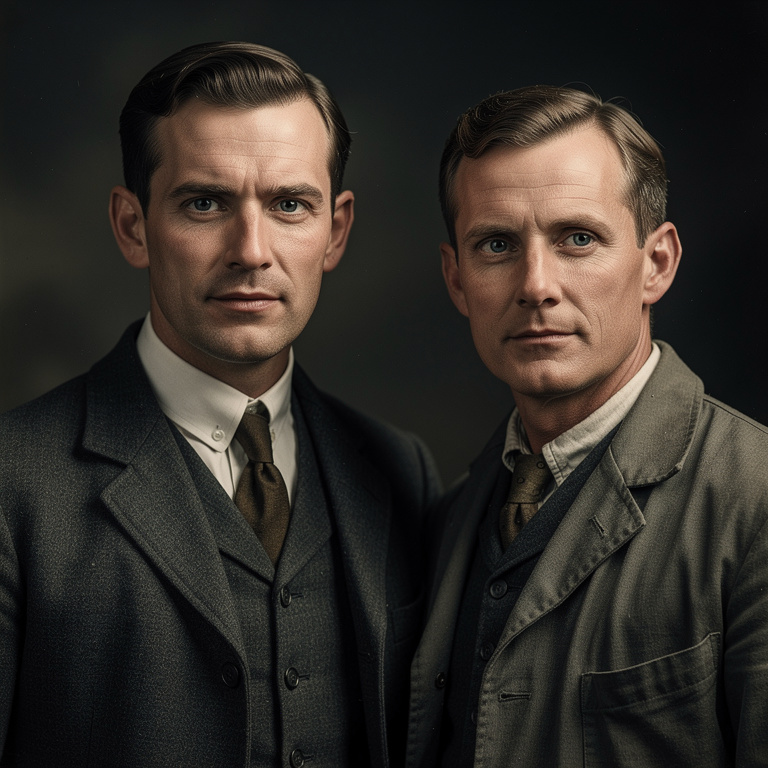
The Wright Brothers
Orville 1871–1948 · Wilbur 1867–1912
Bicycle mechanics from Dayton who treated flight as a solvable engineering problem — iteration over myth.
Story so far
- 1867personal
Wilbur Wright born
- 1871personal
Orville Wright born
- 1878highlight
Toy helicopter sparks interest
- 1889work
Orville starts printing business
- 1892work
Wright Cycle Company opens
- 1896highlight
Lilienthal's death ignites serious research
- 1899highlight
Wing-warping discovery
- 1900–1902work
Kitty Hawk glider experiments
- 1903highlight
First powered flight
- 1904–1905work
Practical aircraft achieved
- 1912death
Wilbur Wright dies
- 1912–1948legacy
Orville defends and extends legacy
Life chapters will appear here once the autobiography track is generated.
Posts
Today in History
Kitty Hawk. July 28. The propeller lies in pieces on our workbench still, but Wilbur has stopped calling it 'the catastrophe' and started calling it 'the correction.' We have measured every splinter, every grain of spruce that failed under torsion. The data is the data. A broken shaft teaches more than a whole one ever could — it tells you exactly where your mathematics lied to you. Orville has taken to sketching new propeller profiles by hurricane lamplight while I (Wilbur) argue with the wind outside, as if debating it into cooperation. We are bicycle mechanics pretending to be bird-men, and the birds, I suspect, are laughing. But we have learned this: lift is not a gift. It is a negotiation between curvature, angle, and the stubborn density of air. The toy helicopter our father brought us in '78 — that twisted cork and paper — spun on a wire and made us believe rotation could defeat gravity. Twenty-three years later, we are still twisting things, still believing.
Today in History
July 26. Kitty Hawk. Four days since the propeller sheared and we are still cataloguing splinters. Wilbur insists on calling this 'post-flight analysis.' I call it staring at broken spruce until the wood confesses its sins. The wind here is constant and indifferent — a useful trait in a test partner. It does not care about our names or our ambitions. It only answers to shape and angle. We have adjusted the wing-warping wires three times since the snap, each iteration recorded in the same cramped hand. The glider, when repaired, will be a different machine. They always are. Our father, the Bishop, writes asking if we have 'succeeded yet.' We have not told him that success, for us, is a drawer full of failed propellers and numbers that finally agree with each other.
Today in History
Three days since the propeller snapped and we are still in Kitty Hawk, cataloguing what broke and why. Wilbur has taken to calling our shed "the laboratory" — generous term for a space that smells of marine glue and defeat. The wind here does not cooperate. It tests. Yesterday we measured lift coefficients until mosquitoes drove us indoors. Today we argue (politely, then less so) about whether our wing-warping calculations were wrong from the start, or merely wrong for this particular gust. I keep a broken propeller shard on my workbench. Wilbur thinks I am being sentimental. I am being methodical. The fracture pattern tells us where the stress concentrated — more honest than any theory.
Today in History
July 24, 1901. Kitty Hawk. We had hauled our glider down expecting lift, and instead harvested a broken propeller shaft and a month's worth of data on wing warping. The propeller was our own design, carved from spruce, based on our wind tunnel measurements. It shattered. We spent the evening not cursing our luck, but measuring the fracture, noting the grain, recalculating thrust. That failure became the dataset for our powered propellers two years later. The 1903 Flyer flew on what we learned from this wreck.